Rampstack Skills
Connect creative direction, product decisions and website operations
A methods library for brand, content, product, SEO, development and operations. Choose a concrete task, supply real evidence, and have your assistant produce a brief, draft, specification or plan that the next stage can use.
 Open original image
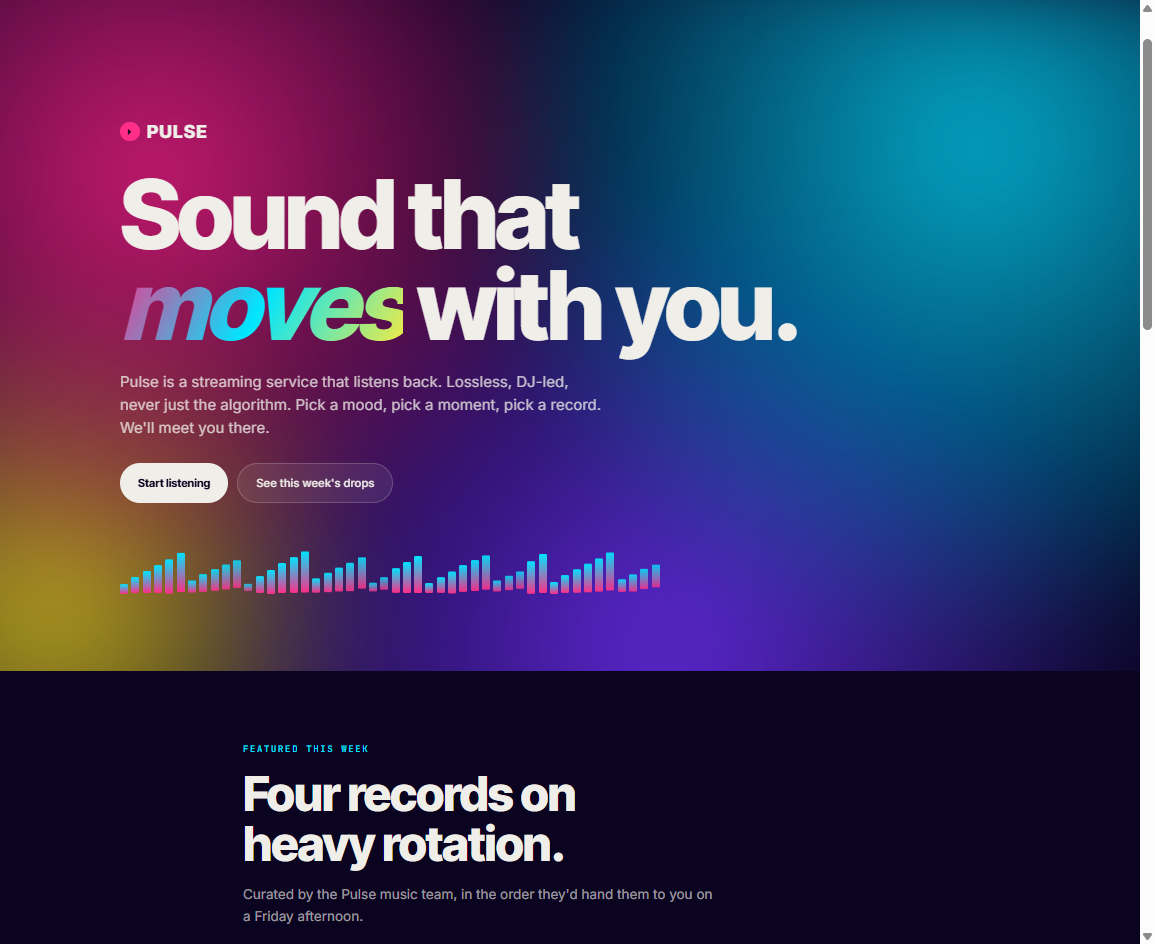
A dark opening, saturated gradients, oversized type and equalizer graphics interpret the direction for music.
View author sourceFictional-brand screenshots from the author’s repository. Both use Playful / Expressive Maximalist / Companion / Resonant, with different palettes, type and imagery. Not generated here or evidence of client outcomes; static images do not verify motion or interaction. MIT © 2026 RampStack Co.
Hosts listed by the author
- Claude Code
- Codex
- Claude web & desktop
- GitHub stars
- 1,004
- Version
- 1.2.0
- Checked
Give the next stage a clear input
For a new site, finish a creative-direction BRIEF.md before asking landing-page-copy to write. For an existing product, start with the actual gap: clarify a feature, diagnose a traffic change, or prepare a runbook when a launch is approaching.
Pick a task and get started
Install the complete plugin in Claude Code, then supply one task and its materials. For a first run, use two short files to establish creative direction and inspect BRIEF.md before moving to copy.
For a new site or redesign. Discuss four axes and turn preferences into a brief shared by design and copy.
Install the plugin inside Claude Code
Run each line inside a Claude Code session: add the marketplace, then install the full plugin. These are not ordinary shell commands. Follow the author’s relevant setup path for other hosts. Installation retrieves current repository content; this guide reviews a pinned commit.
Read the author’s setup guide/plugin marketplace add rampstackco/claude-skills /plugin install rampstack-skills@rampstackFirst run: two input files and a direction brief
Create project-context.md with the product, audience, desired user action, budget, language and implementation constraints. In references.md, list 2–4 real reference URLs and what you like or dislike about each. After installation, confirm creative-direction is available and can read both files, then send the first task. If a URL cannot be opened, supply a sourced screenshot or excerpt. Review the choices, reasons and open questions in BRIEF.md before handing it to the copy task.
Read the author’s installation and invocation guideGive your AI this first task
These editorial invocation examples follow the reviewed source. Filenames are suggested conventions to replace with real materials. Expected files are not results produced by this site.
Use creative-direction with project-context.md and references.md. Establish the project, audience, goal and constraints. Discuss tone, aesthetics, audience relationship and sensory ambition one axis at a time. Explain practical consequences, then record my decision and rationale; do not silently choose all four for me. For each reference, say what you actually inspected and what it contributes. Report inaccessible links. Surface conflicting choices and their tradeoffs for confirmation. Follow references/brief-template.md and save BRIEF.md at the project root: project description, four choices with reasons, synthesis, reference interpretations, rejection list and open questions. Check whether it can guide downstream copy and design without hiding unresolved decisions. Complete the direction in this task; do not implement the website.
Check what you receive
- A BRIEF.md that downstream design and copy tasks can use.
- Reasoned choices, traceable references, concrete exclusions and explicit unresolved decisions.
More about this skill
Rampstack’s claude-skills is a methods library rather than a single website-building tool. The reviewed commit contains 107 skill folders across 16 categories, covering brand and design, content, search, product, development, growth and operations. Individual files explain the use case, required materials, decisions and deliverables; supporting references turn the methods into templates and checklists.
Its useful unit is a handoff. creative-direction records tone, aesthetics, audience relationship and sensory ambition in BRIEF.md. landing-page-copy uses that direction to organize a page from hero to action. pm-spec-writing grounds implementation in problem evidence and acceptance criteria, while experiment-design establishes metrics and decision rules before a test. The saved artifact becomes the next task’s input instead of asking every task to rediscover the project.
This guide develops six paths without requiring the whole catalog in one session. Brand and copy work can begin with local documents. Foundation SEO and the Ahrefs audit suite have different prerequisites; the latter needs actual data access. Experiment design produces a plan, and launch-runbook organizes a launch. Traffic assignment, deployment, DNS changes and messaging still require suitable tools and an explicit scope.
The author’s showcase uses fictional brands. Pulse and Bloom below share the same four-axis direction but differ in palette, typography, imagery and category expression. The framework guides choices; four labels do not determine a finished design. These are author screenshots, not runs by this site or evidence of real products, customers or conversion results.
The main repository’s workflows connect skills into phased procedures for ongoing content and growth work. Install the catalog they invoke, open a chosen workflow, check its prerequisites, and follow its run examples, artifacts and completion criteria. Starter, SEO and PM are separately maintained subset repositories for people who need a smaller catalog. Workflow status describes the author’s execution evidence; required data, tools and engines still need separate setup.
Apply the material with judgment. Suggested durations, sample-size tables, SEO cause patterns and persuasive sample copy are not facts about your business. The author explicitly permits a deliverable that states missing required data. Our tasks preserve that rule and separate observations, hypotheses and proposed actions.
Sources and verification
Sources checked
Based on the pinned README, six skills, relevant references and workflow documentation. No third-party installation, paid data calls, generation tasks or launch operations were executed.