Interviews, discovery, PRDs and critical review
PM Skills
From User Evidence to Product Decisions
Paweł Huryn’s product-management plugins turn interview synthesis, assumption testing, PRDs and roadmaps into guided workflows. Choose the decision, supply real material, and use the assistant to organize and challenge it while the team gathers evidence and makes trade-offs.
Hosts listed by the author
- Claude Code
- Codex
- Cursor
- Gemini CLI
- OpenCode
- Kiro
- GitHub stars
- 27,521
- Version
- 2.2.0
- Checked
- Categories
- Product & Project
Start with one decision that is currently blocked
Summarize interviews when you have them; plan discovery and tests when evidence is missing; write a PRD once choices exist. Then challenge the assumptions that matter instead of generating more documents merely to complete frameworks.
Pick a task and get started
Install the two plugins below in a terminal, then open a Claude Code session with access to your project material. Pick one task, provide its inputs and send the prompt. Continue through any decision checkpoints.
Bring an actual transcript or notes and identify omissions. This task organizes an interview you already conducted; it does not recruit participants or automatically transcribe an audio recording.
Install the two plugins used in this guide
Run these lines in your local terminal. The first adds the marketplace; the next two install the plugins required by this guide. This does not install every plugin. Use the prompts in a Claude Code session afterward; consult the author’s instructions for other hosts.
Read the author’s setup guideclaude plugin marketplace add phuryn/pm-skills claude plugin install pm-product-discovery@pm-skills claude plugin install pm-execution@pm-skillsPrepare evidence, decisions and unknowns separately
Choose a project folder and add context plus the input for your selected task. Replace participant identities with IDs while preserving paragraph locations or timestamps. Confirm discovery and execution appear in the host’s plugin list; if commands are missing, check installation and follow the host’s reload guidance. Afterward, open the file actually saved instead of relying only on a completion message.
Read installation and host differencesGive your AI this first task
These editorial examples follow the current commands and skills; they are not captured test runs. Replace the example filenames with your real material and supply missing files before starting.
/interview summarize Read the attached interview-01.txt. We are studying how small design studios get client approval on design work. Summarize the participant’s context, their most recent approval process, current tools, difficulties, what works, surprises and follow-up questions. Use an anonymized participant ID. Support each important insight with an exact quote and an available timestamp or paragraph location. Separate stated intentions from actions they actually took; preserve contradictions and counterexamples. Mark missing dates, numbers and owners as unknown. Check quotations against the source, save the summary as Markdown and return the actual path. If the attachment is missing, ask for it first.
Check what you receive
- An interview summary covering the current workflow, intended outcomes, problems and sources of satisfaction, with important interpretations linked to the transcript.
- Follow-up actions and open questions, plus a saved Markdown path when the host can write files. The summary retains the limits of a single interview.
- Spot-check quotes and references. Ensure polite praise has not become purchase intent and one participant’s experience has not become a market-wide conclusion.
More about this skill
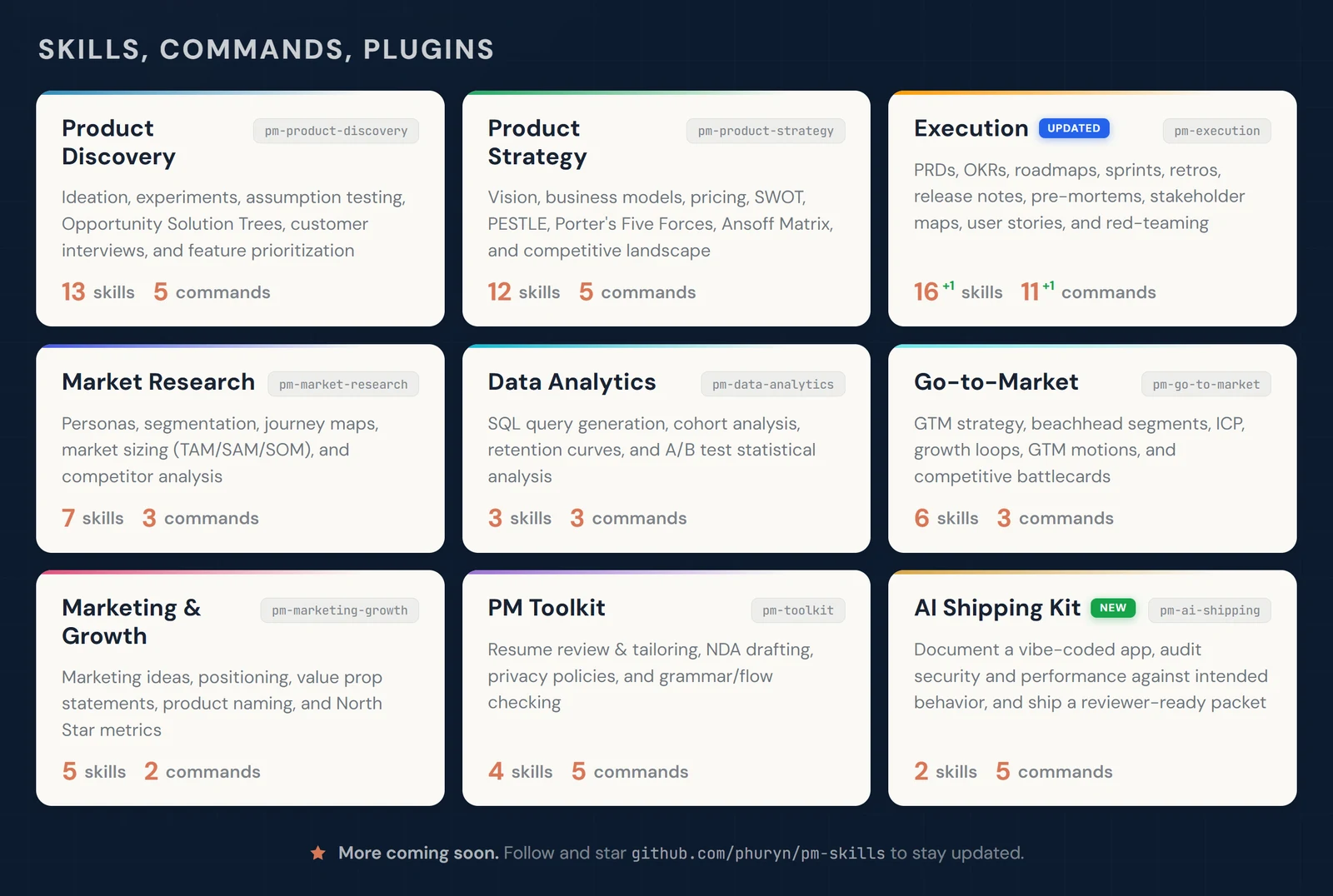
Maintained by Paweł Huryn, PM Skills groups methods into product discovery, strategy, execution, market research, analytics, launch and growth plugins. A skill supplies a method, a command connects methods into a workflow, and a plugin is the installation unit. For example, /discover distinguishes new from existing products before moving through ideas, assumptions, prioritization and experiment design. Its purpose is to support a product decision.
This guide follows a practical sequence: make interview evidence traceable, decide what to validate next, define a first-version PRD, and question the conditions the plan relies on. Any step can expose a gap. A discovery plan is not a test result, and positive interview feedback does not establish demand. When evidence is missing, the useful next output is a question and a way to investigate it.
The workflows have different rhythms. Discovery pauses for idea selection and critical assumptions. A PRD defaults to a lean one-to-two-page document focused on what blocks the first-version decision. Red-teaming narrows attention to a few assumptions that could invalidate the plan and the cheapest tests for them. There is no need to run every framework for every task.
Installation and invocation must match. The five examples here use the discovery and execution plugins and the author’s Claude command forms. Other hosts may load only skills or require natural-language sequencing; do not assume identical slash-command support. The retained pm-ai-shipping entries now provide migration guidance: the actual AI Shipping Kit is maintained in the separate product-engineering repository.
The source is MIT licensed and uses your assistant account and model allowance. The selected document workflows do not require an additional dedicated API key. Public research, attachment access and file saving depend on the host. The deliverables are documents and test plans that can be reviewed; interviews, experiments, engineering estimates and implementation remain work for the team.
Sources and verification
Sources checked
Checked the pinned README, marketplace and plugin manifests, all five workflows and their relevant skills, plus the engineering-tool migration notices. We did not install the plugins, call a model or run these examples.