Turn requirements and plans into a checkable /goal
Qiaomu Goal
Define What Done Means
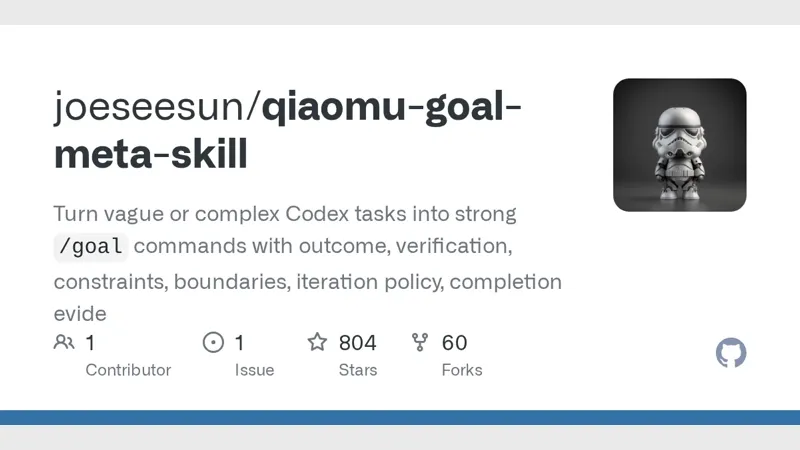
Qiaomu’s drafting skill turns a vague request into an outcome, verification, constraints, write boundaries, iteration and completion conditions. It proposes a usable draft first, then offers a few focused choices for multi-step development or research.
Hosts listed by the author
- Claude Code
- Codex
- GitHub stars
- 900
- Version
- 0.2.0
- Checked
Finish one draft before deciding to activate it
Start with a bounded task and ask for a draft only. Check the constraints, completion evidence and existing authorization, then submit one reviewed /goal to a host that supports it.
Pick a task and get started
Run the installer from the target project’s root and select Codex. Once the skill is available, attach the task material and use a drafting prompt below. Review the saved file before separately activating a goal.
Start with the request and project context, then obtain a proposed execution contract. Useful when the problem is clear but scope and completion are not.
Install the drafting skill in this project
Run the author’s command from the target project root and select Codex when prompted. Installation is project-level by default; -g selects user-level installation. Paths and checks below assume the project installation. Install and invoke it in your own assistant.
Read the author’s setup guidenpx skills add joeseesun/qiaomu-goal-meta-skillFirst run: install locally and save one goal per language
Select Codex during installation. Its default project path is .agents/skills/qiaomu-goal-meta-skill/, containing SKILL.md, references/ and scripts/. The author’s ~/.agents check targets a global location and does not verify this project installation. Prepare brief.md and project-context.md, confirm the skill is loaded, then use the first task. Check that goals/register-en.txt contains one /goal, meaningful fields, grounded commands and the intended scope. Continue with the text and semantic review task.
Check installer destinations by hostGive your AI this first task
These editorial examples follow the author’s workflow and default to drafting or reviewing only. Replace the filenames with real inputs. Do not execute the generated /goal as part of the drafting request.
Use qiaomu-goal-meta-skill to draft, not execute, a goal for making the existing mobile sign-up flow clearer. Read brief.md and project-context.md. Define success as a first-time visitor understanding required fields, interpreting errors and completing the existing sign-up flow; preserve account rules and APIs. State low-risk assumptions, give numbered options only for decisions that alter cost, risk or product direction, and explain the defaults in one sentence. Cite only verification commands supported by the project material; arrange discovery where they are unknown. Define allowed changes, desktop and mobile evidence, investigation after failure, completion and genuine unresolved blockers. Preserve existing authorization without expanding the task. Write English only, with /goal followed by the standard English labels, one substantive field per line. Save goals/register-en.txt and put rationale and choices in goals/register-notes.md. Review all seven elements, paths and assumptions, then run the bundled checker from its confirmed location and retain the result. Mark lint unperformed if the environment is unavailable. Deliver the draft without starting it.
Check what you receive
- One English goal file without template blanks, with rationale and choices saved separately.
- Check the outcome, command sources, scope and authorization. Missing evidence requires a discovery step, not fabricated certainty.
More about this skill
Qiaomu Goal Meta Skill works on the definition of a task before implementation. Given “make sign-up easier,” it should identify the user’s outcome, how to demonstrate it, what behavior must stay intact and where changes may be made. The output is an instruction. Producing it neither fixes sign-up nor starts persistent execution.
The author leads with a recommended draft. Low-risk gaps become explicit assumptions, followed by a brief rationale and options only where cost, risk, ownership or direction would change. Four questions are not mandatory. Chinese requests receive an English mirror by default; a request for one language overrides that default.
The seven elements are outcome, verification, constraints, boundaries, iteration policy, completion and pause conditions. They are this skill’s writing format and checking convention, not mandatory fields in Codex’s /goal syntax. Constraints protect behavior; boundaries restrict where work happens. Completion needs evidence, while a blocker needs an explanation of what is missing.
An existing plan can be converted while preserving dependencies and scope. An unfamiliar domain calls for inspecting project documentation, samples and authoritative material first. Broad directions such as “professional” become checks for hierarchy, readability, interaction and screenshots. The default of up to three focused improvement rounds is adjustable; exhausting it does not prove completion.
A lightweight checker can identify some missing markers, placeholders and vague instructions. It cannot determine whether commands exist, permissions are appropriate or two languages agree. The repository is MIT-licensed. Drafting consumes your host’s model allowance, and later execution needs the relevant tools, permissions and resources.
Sources and verification
Sources checked
The pinned source, all three references and checker were read, with installer and official OpenAI Goals documentation checked separately. No skill was installed, third-party checker run or goal activated.