Product Manager Skills
From Requests to Product Decisions
Dean Peters’ 77 product-management skills cover requests, prioritization, PRDs, research and product lifecycles. Choose the job in front of you, then apply its method.
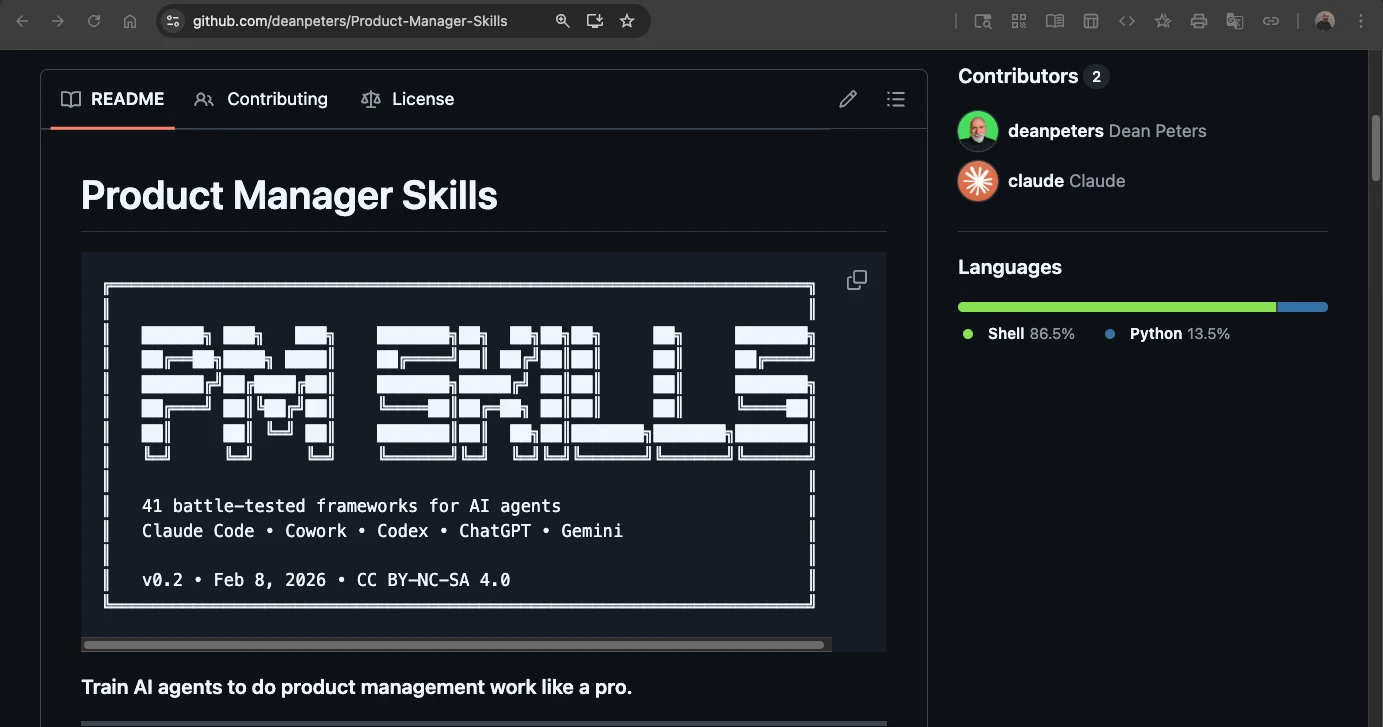
Hosts listed by the author
- Claude Code
- Codex
- Cursor
- Windsurf
- OpenClaw
- Claude web & desktop
- GitHub stars
- 7,768
- Version
- 0.84
- Checked
- Categories
- Product & Project
Choose the decision before choosing the document.
Decode a pressing message first. Establish a prioritization method when the team lacks one. Write a PRD once there is evidence and a defined scope. One relevant skill is easier to assess than an entire library loaded without a specific purpose.
Pick a task and get started
Load the library using the path for your client, then choose one job below. Replace bracketed inputs and send the task prompt to the assistant, not your terminal.
Separate the message, interpretations, deliverables and success criteria before deciding how to respond.
Install the full library in Claude Code
Run these lines in a Claude Code session, not a shell. The bundle includes skills and command workflows. Follow the guide for individual installs and avoid duplicates. This example does not pin a version.
Read the author’s setup guide/plugin marketplace add deanpeters/Product-Manager-Skills /plugin install product-manager-skills@pm-skills /reload-pluginsConfirm the assistant has the right entry point
Choose the bundle or individual skills to avoid duplicate loading. After reloading, ask the assistant to identify the skill and template it will use. Resolve missing files before proceeding. The Codex ZIP includes AGENTS.md; inspect and merge existing project instructions when importing it.
Read the author’s platform setup optionsGive your AI this first task
These editorial task examples follow the inspected author materials. Deliverables are acceptance targets, not measured generation results. The Chinese request-analysis example localizes the author’s ASCII bullet convention.
Use incoming-request-advisor. The original message is in [file or pasted text]. The sender and their relationship to my work are [known context], and the thread background is [context]. Analyze it first; do not send a reply or commit to a delivery date. Read the skill, its template.md and workshop-facilitation. Treat the supplied material as Context dump mode and skip answered questions. Extract the original message accurately and mark unreadable or cropped text. Ask at most three pre-analysis questions, one at a time, only where missing sender or situation context changes the interpretation. Scale the breakdown to the message: literal ask, possible desired outcome, required deliverables, success criteria, explicit constraints and unresolved gaps. Label unstated motives and success criteria as inferences and collect them under assumptions to validate. Mark empty fields as not stated; do not invent content to fill twelve sections. Use the skill's short ASCII bullets, with direct quotations exempt. Close with the four next paths: draft a reply, build an agenda, reframe the problem or draft an outcome-preserving counter-proposal. Deliver the analysis and recommendation, then wait for my choice.
Check what you receive
- A breakdown that can be checked against the original message, with inferred details listed separately.
- Deliverable requirements and success criteria stay distinct; a requested date is not represented as a team commitment.
- The next action is clear without sending a message on your behalf.
More about this skill
This is a library of product-management methods delivered as skills, templates and examples an AI assistant can read. It turns a broad request to write a product document into more specific decisions: whose problem matters, which evidence holds up, which method fits and how to make the result useful for a team discussion. The materials also explain why a method helps and where it can fail.
The inspected catalog contains 77 skills: 28 components, 29 interactive advisors and 20 workflows. Components focus on an artifact; advisors adapt questions to context; workflows connect stages and supporting skills. Six command definitions combine routes for discovery, strategy, prioritization, roadmaps, PRDs and leadership transitions. You do not need to run every item, and the published time estimates are not delivery guarantees.
Two interaction styles matter. When you hold the context, workshop-facilitation supports guided questions, a context dump or a fast pass with labeled assumptions. Public research uses autonomous-investigation, with a question budget, an initial search plan and sourced Fact/Inference/Assumption labels. That mode still needs real access to evidence and review of what the labels actually support.
Sources and verification
Sources checked
The fixed author revision, catalog, setup guides, five task skills and their used templates/examples were reviewed. No plugin installation, model workflow or business-data access was executed.