What you get
A traceable agent-skill health report: an overall grade, three core dimensions, the most important failure patterns, and candidate skill edits backed by real conversation evidence.
Skill Doctor: Improve Agent Skills from Real Conversations
Added 2026-08-29Sample real local Warp, Claude Code, or Codex sessions; score agent efficiency, code quality, and skill coverage; then turn failed-session evidence into small, concrete skill edits and a one-page report.
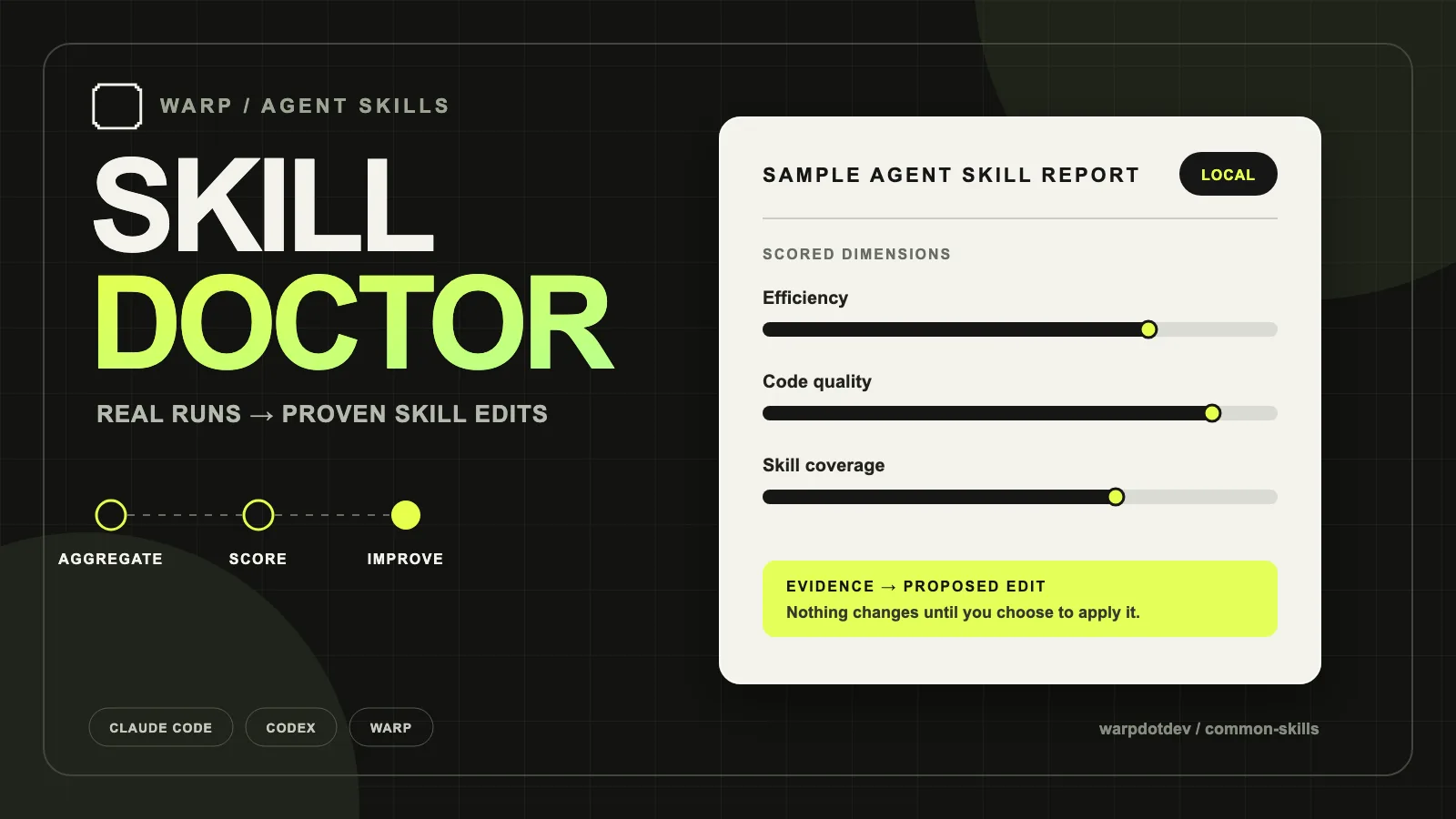
Skill Doctor first asks whether to analyze the current repository, selected projects, or all local conversations, and whether to evaluate project skills alone or include global skills. By default it looks back 45 days and samples at most 12 sessions. It inventories local Warp, Claude Code, and Codex records, scores every sampled conversation against efficiency and code-quality rubrics, and combines those results with skill coverage; sessions without enough code evidence are excluded from the code-quality average instead of being forced into a verdict. Suggestions may come only from conversations that actually failed and must identify a verified, reusable instruction gap. Model variance, ignored existing guidance, and generic reminders do not qualify. When the evidence clears that bar, the skill writes complete candidate SKILL.md files, unified diffs, and a self-contained HTML report into a temporary directory; the report can also export a local share image. Transcripts, session files, and excerpts stay on the machine, and the real skills are never changed automatically. The current release supports Warp, Claude Code, and Codex and requires Python 3 plus an agent environment that can read local sessions and run scripts. The repository is MIT-licensed. Install through the skills CLI with npx skills@latest add warpdotdev/common-skills --skill skill-doctor, adding the target agent and scope flags you need.