Planning, literature synthesis, screening and simulated review
Academic Research Skills
From Research Material to a Checkable Manuscript
Cheng-I Wu’s academic collaboration suite offers separate workflows for research, writing, record screening and simulated review. Develop one manuscript from real material while retaining sources, checking records and the author’s decisions at each stage.
Hosts listed by the author
- Claude Code
- GitHub stars
- 54,539
- Version
- 3.24.0
- Checked
- Categories
- Writing & Research
Complete one bounded task with material you already have
Plan chapters when you have results but an unsettled structure. Synthesize a supplied paper set when you need a review section. Confirm a protocol and pilot when you have database exports. Choose the full workflow when you need a manuscript and can review each stage.
Pick a task and get started
Install the plugin in Claude Code, open your research directory and prepare the files for one task below. Send its prompt and complete the required dialogue or checkpoints. Open the saved output and check it against the input.
You have a direction, methods or results but need to turn them into an argument. Bring the actual material and develop a plan through dialogue. If the research question itself is unsettled, begin with deep-research in socratic mode.
Install the suite inside Claude Code
Enter these lines inside Claude Code: add the marketplace, then install and enable the suite. Use the fully qualified commands below afterward. This is the plugin route; uploads, imports and separate distributions for other hosts do not provide an identical runtime.
Read the author’s setup guide/plugin marketplace add Imbad0202/academic-research-skills /plugin install academic-research-skillsConfirm the plugin loads before starting a paper task
Install and enable the plugin in a Claude Code session that can read your research files. Begin with /academic-research-skills:ars-plan and a well-defined planning task. The assistant should load the full academic-paper instructions and ask about the research foundation, rather than answering from the command summary alone. Resolve missing commands or supporting files first. Keep originals, working copies and outputs separate, and retain the Material Passport needed for later handoffs.
Read the author’s installation prerequisitesGive your AI this first task
These editorial examples follow the pinned source version. They are neither author case studies nor tested generation results. Replace the example filenames with real materials. Prompts use fully qualified commands; recent Claude Code versions may also expose /ars-* aliases.
/academic-research-skills:ars-plan I am studying how hybrid teams share tacit knowledge. Read research-brief.md, method-notes.md and findings.md first, and establish which question, literature, methods and actual results I have. List missing files before proceeding. Guide me through the chapters with questions so I articulate the central argument, contribution and counterevidence myself. Turn my answers into a Chapter Plan and INSIGHT Collection. For each chapter, identify its purpose, argument, available evidence, missing material and proposed length. Keep unfinished research as work to do, never as results. Preserve my meaning in the contribution statement and leave unanswered questions open. After I confirm the structure, save the plan as Markdown, return the path and check that every major claim has evidence or an explicit evidence-gathering task. This run is for planning only.
Check what you receive
- A Chapter Plan and INSIGHT Collection connecting claims, evidence, counterevidence and unfinished research.
- Check that the contribution comes from your answers and that planned work has not become a reported finding. Decide on full drafting after the plan is agreed.
More about this skill
Academic Research Skills (ARS) is a suite for researchers using Claude Code. It currently contains five modules: deep-research, academic-paper, academic-paper-reviewer, academic-pipeline and SR-Screener. Choose a single task, such as planning an argument or auditing references, or connect research, drafting, review and revision through a staged workflow.
The most useful starting material is work you have already done: a research question, reading notes, a method proposal, actual data or findings. Plan mode asks you to explain each chapter’s purpose and evidence; literature-review mode organizes sources into an argument. The author retains the question, contribution and methodological choices. Missing evidence should become an open question or a research task.
SR-Screener works on records already retrieved and exported. It fixes eligibility rules before a pilot, title/abstract screening, conflict handling and QC; full-text screening needs the corresponding papers. It runs separately and can hand its screened corpus to the writing workflow. It is not an automatically dispatched pipeline stage, a full-text data-extraction tool or a meta-analysis engine.
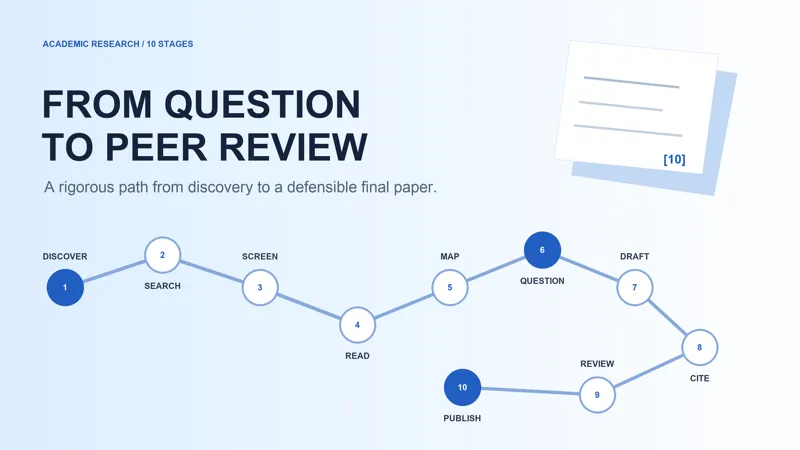
The full pipeline schedules Stage 2.5 after drafting and Stage 4.5 after revision, preserving evidence about citations, claims and changes. Some controls are protocols followed by the model; others are scripts whose availability depends on Python, the installation channel and the calls actually made. Read the checked populations, coverage limits and unknown states instead of interpreting PASS as proof of the entire study.
Simulated review applies different perspectives to the same manuscript and returns criterion-based, evidence-anchored feedback and a revision roadmap. Separate roles do not establish independent human review or independent errors. Current reviews do not map a legacy 0–100 total to acceptance. The researcher decides which advice to follow and whether to submit.
Sources and verification
Sources checked
Checked the pinned author documentation, task entry points and relevant verification code. The plugin was not installed and the research tasks were not run; generated writing, screening and simulated-review quality were not evaluated.