2026-09-27AITao
Ben Thompson: Who Pays for the AI Boom?
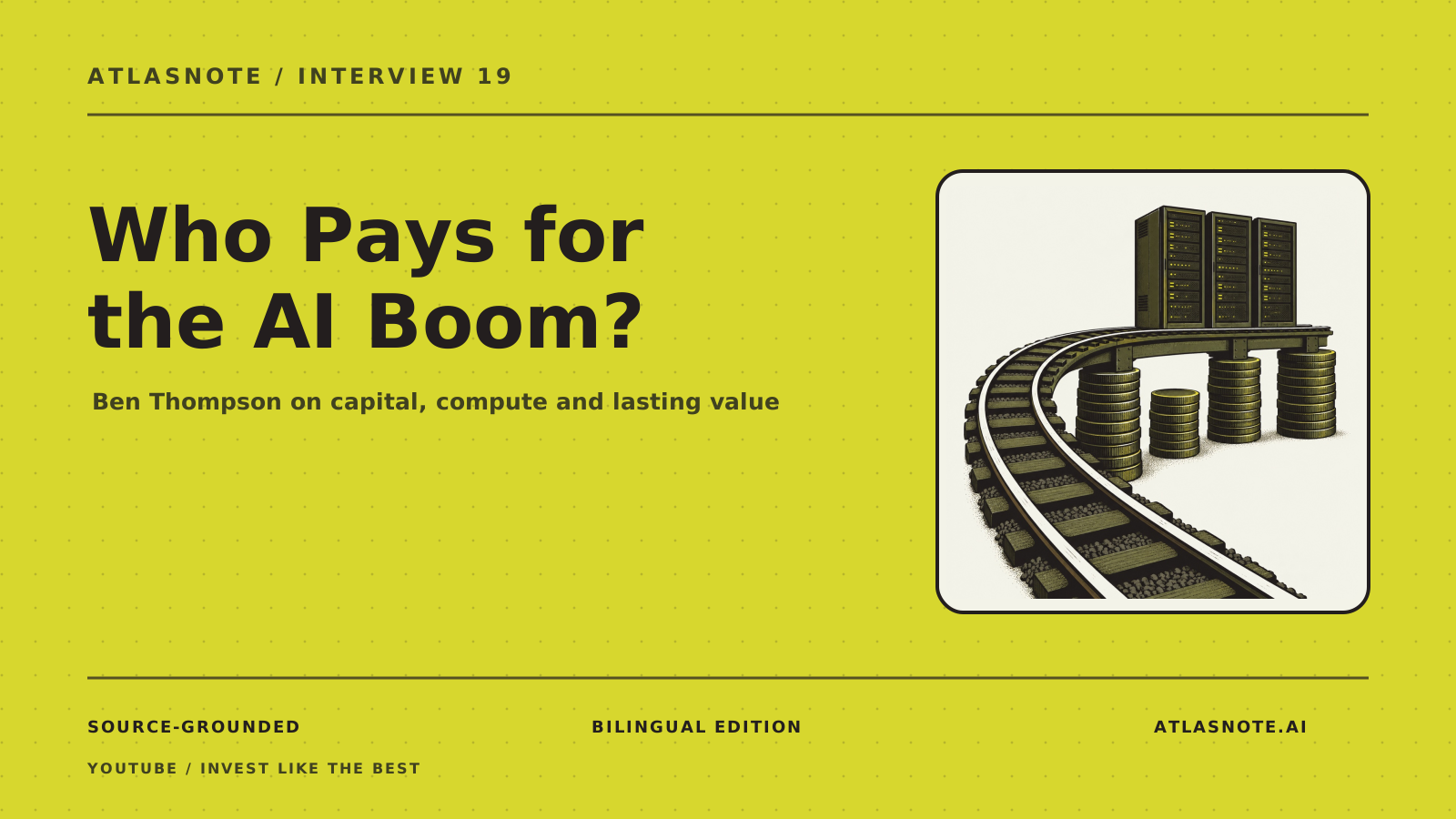
AI can create lasting economic value while its builders face a near-term funding gap. Ben Thompson connects railroads, shipping and chip cycles to inference costs, big tech's business models and the infrastructure this boom may leave behind.
Contents11 sections
- The Money Leaves Before the Revenue Arrives
- Google's Search Business May Finance a Much Larger One
- Strong Capabilities Still Leave Questions About Their Limits
- Free Models, Paying Customers and a Bill That Needs Reconsidering
- Today's Compute Shortage Does Not Guarantee Tomorrow's Prices
- TSMC's Capacity Discipline Transfers a Cost to Its Customers
- Amazon and Apple Have Customers and Physical Assets
- Frontier Models, Enterprise Relationships and Advertising
- Nvidia's Economics Extend Beyond the Chip Sale
- Geopolitical Leadership Has Conditions and Costs
- Power Infrastructure May Outlast the Boom
Original source: What Happens When the AI Boom Runs Out of Money
Program: Invest Like The Best. Guest: Ben Thompson, founder of Stratechery. Host: Patrick O'Shaughnessy. Video published on 2026-08-18. Duration: 01:25:54.
This article draws on the public video and its automatically generated English captions. Financing examples, industry estimates and company outlooks retain their context from the interview; the speaker's judgments and forecasts are not treated as established outcomes. Each section links to the relevant video passage.
A data center comes online and its capacity is immediately taken. With demand like that, another round of investment seems straightforward.
Ben Thompson asks a question further up the chain. Busy computers do not necessarily mean the industry has earned enough money to finance its expansion. Construction must be paid for now. Customers need time to create value, generate dependable revenue and pass that revenue back to infrastructure suppliers.
AI can be an economically valuable technology while some of its investors run out of money before the returns arrive.
That distinction connects the arguments throughout this interview. Thompson is optimistic about AI's economic impact. His questions concern who bears the costs, who owns the customer relationship and whether long-term value can pay the bills arriving today.
The Money Leaves Before the Revenue Arrives
Thompson describes a funding sequence: technology companies spend their free cash flow, raise debt, then issue equity or bring in long-duration institutional capital, including pension and insurance funds.
In the discussion, he points to Google equity financing and an Nvidia-linked financing arrangement of roughly five hundred billion dollars. His question is what supplies the next dollar after those sources. These are examples discussed in the interview, not evidence that every company's borrowing capacity has been exhausted.
Ideally, the new businesses start generating enough free cash flow to fund further construction. A gap opens if that revenue arrives more slowly than financing is consumed.
The host also cites estimated capital spending of roughly eight hundred billion dollars in 2026 and $1.3 trillion in 2027. The conversation does not establish a consistent measurement scope for those estimates; they should not be read as audited industry totals.
Thompson uses the railroad expansion of the 1870s to explain the timing problem. Construction requires money upfront, while operating returns may take a decade or several decades to materialize. Financing can break down and investors can lose money even as trains keep moving goods and contributing to the economy.
A technology's usefulness, an asset's revenue and its original investors' returns are separate questions. Video: financing and the railroad analogy.
Google's Search Business May Finance a Much Larger One
Thompson's comparison between Google and Berkshire Hathaway is about finding new uses for capital.
See's Candies can earn high margins, but there is a limit to how much additional investment the candy business can absorb. BNSF requires substantial physical assets and has less attractive percentage margins, yet its scale can produce a large absolute profit.
Google search occupies a comparable position: it is already an exceptionally profitable business. AI requires substantial continuing expenditure and may never match search's returns on each dollar of revenue. Its potential market, however, could extend across a large share of white-collar work.
In Thompson's framework, accepting lower margins or equity dilution can still lead to a larger absolute profit. The new market and revenue must actually materialize for that trade to work.
This helps explain the willingness to invest. It also shows why a highly profitable existing business cannot, by itself, establish that the next investment will pay off. Video: Google and Berkshire.
Strong Capabilities Still Leave Questions About Their Limits
Thompson is enthusiastic about progress in coding and mathematics while retaining a specific reservation: success on tasks with readily verifiable answers does not establish equal reliability on open-ended problems.
Code can be executed and mathematical results checked. Many decisions in the real world have much slower feedback. Whether models can bridge that difference remains, in his view, a question requiring evidence.
He also argues that written material on the internet primarily records the outputs of thought, without necessarily capturing all the reasoning that produced them. Richer data might expand model capabilities further, but that is a possibility he proposes.
Neither concern erases the market already available. A large share of economic activity involves tasks with reasonably clear rules and checkable outcomes. Even without further model improvements, he sees a substantial opportunity.
Medicine is another area where he sees potential, alongside obstacles involving data access, regulation and organizational processes. Rapid technical progress does not guarantee equally rapid adoption. Video: capabilities and verification.
Free Models, Paying Customers and a Bill That Needs Reconsidering
Open models can spare adopters the original research expenditure. They do not pay for the inference needed to serve a request. Someone still has to cover hardware, electricity and operating costs.
Those costs also vary considerably. Asking for a recipe and running an extended search for a mathematical solution are very different workloads. Thompson suspects that casual consumer requests can be inexpensive to serve, while prolonged reasoning keeps accumulating compute costs.
That makes a single business model for all AI usage difficult.
For mainstream consumers, Thompson favors advertising. Dropbox illustrates his concern: widespread appreciation for a product does not guarantee enough individual subscribers. Selling to businesses also requires permissions, administration and organizational controls that a consumer product may lack.
He argues that OpenAI's reliance on consumer subscriptions encountered a similar limit. He criticizes its delay in pursuing advertising, which can keep light usage free while businesses pay to reach customers. This is his business judgment, not a claim that every consumer subscription must fail.
The reasoning follows his Aggregation Theory: as distributing information becomes cheaper, helping people discover what they want and controlling access to that demand become valuable positions.
Enterprises face a different complication. Thompson uses a software fee of $100 per employee per month as an example. A fixed seat price can be incorporated into the cost of hiring an employee. Once the decision is made, the payments continue.
Adding usage charges invites a new decision each month about how much to spend. It can also encourage customers to examine the entire suite, compare individual products and consider alternative suppliers. Predictable bundled revenue becomes subject to more frequent scrutiny.
Inference costs change purchasing behavior and budgeting as well as gross margins. Video: aggregation, advertising and pricing.
Today's Compute Shortage Does Not Guarantee Tomorrow's Prices
Thompson argues that technology companies are accustomed to charging for differentiation and may be less familiar with the cycles of shipping or memory manufacturing.
After a ship has been purchased, its owner still needs to decide whether to accept another cargo. If the price covers fuel, crew, port fees and other incremental cash costs, operating can make sense even when depreciation produces an accounting loss.
During a shortage, freight prices rise and operators order more ships. Construction takes time. Demand and pricing can change before the new vessels arrive.
He applies that logic to data centers. An attractive payback period measured during a compute shortage may not survive a substantial increase in supply.
In his commodity-market framework, pricing depends on the marginal supplier and the balance of supply and demand. Lower-cost operators can generally withstand lower prices for longer, giving them a better chance of surviving a downturn.
He allows that AI demand could keep growing and compute could remain scarce. Even then, the gap between committing capital and generating enough revenue can interrupt financing. Video: shipping and compute cycles.
TSMC's Capacity Discipline Transfers a Cost to Its Customers
Thompson argues that caution in manufacturing expansion during 2023, 2024 and 2025 will affect supply for years. He places the arrival of some capacity funded by current investment around 2028 and 2029. These are his assessments of the construction cycle.
Manufacturers have reasons to be cautious. He uses a fab potentially operating for 30 years to illustrate the concern: excess capacity built today can remain in the system for a long time. That is an operating-life assumption, not a claim that every fab needs 30 years to repay its investment.
Caution does not eliminate risk. A manufacturer reduces its exposure to overbuilding while customers bear the cost of missing chips. That cost can take the form of orders they cannot fulfill and profits they cannot earn.
This can create an opening for Intel and Samsung's foundry businesses. A customer with a dependable supplier previously had little reason to absorb the expense and operational difficulty of helping a second one develop.
When foregone revenue becomes large enough, paying that cost can become worthwhile. Thompson consequently sees an opportunity for Intel to attract a significant customer. It remains an opportunity and a forecast, not proof that Intel's transformation is complete. Video: manufacturing and second sources.
Amazon and Apple Have Customers and Physical Assets
Asked about the strongest business positions, Thompson starts with Amazon. It can address problems its own operations genuinely face, turn those capabilities into products and sell them to others.
The history matters. In his account, AWS did not begin by renting out spare retail servers. It grew from the need for infrastructure accessible through interfaces and initially served outside customers before Amazon's retail operations migrated onto it.
Logistics followed a different sequence: Amazon built capacity for its own delivery needs and then opened services to third parties. The common advantage is a real business providing demand, feedback and scale.
Custom chips can benefit from that environment. Graviton is AWS's Arm processor family, while Trainium is an AI accelerator. Internal workloads and managed services can support repeated hardware improvement. The two chip families should not be treated as serving the same purpose.
Apple's position rests on devices, distribution and customer relationships. Thompson argues that it can source models from suppliers and potentially move more lightweight inference onto users' devices, reducing the cloud costs it bears. He explicitly says that this state has not been fully reached.
Apple also faces a strategic question. If AI becomes available throughout homes, computers and other devices, will the phone remain the center? Thompson invokes Microsoft's early tendency to interpret mobile through the PC as a reason to question whether today's successful arrangement will last.
Making and distributing physical goods gives both companies a relatively durable foundation. They still have to judge where customers will access the next generation of services. Video: Amazon and Apple.
Frontier Models, Enterprise Relationships and Advertising
OpenAI and Anthropic lack the same established businesses to underwrite their ambitions. Thompson sees strong technical conviction and the need to make the new business work as powerful incentives.
Google can support investment with search revenue. Meta combines an advertising business with its founder's determination to pursue frontier research. Discussing SpaceX's AI activities, Thompson finds differentiated infrastructure potentially compelling but questions whether an attractive infrastructure business necessarily needs its own frontier model. Space-based data centers remain a future scenario in this argument.
He views Microsoft's approach as similar to IBM's role in helping enterprises adopt the internet: offer familiar interfaces, compatibility and services while managing changes in the underlying technology.
That has practical value and a defensive purpose. If agents can complete work directly, users may become less dependent on documents, inboxes and conventional interfaces. Existing customer relationships can buy time without guaranteeing that established product forms remain essential.
Meta's nearer-term payoff can be observed in advertising. Clicks, purchases and repeated experiments offer a way to test generated images and copy. Thompson suggests that a few percentage points of improvement could represent billions of dollars. That is a scale-based argument about potential returns, not a report of realized net profit.
He also distinguishes the content economics of platforms. YouTube shares revenue with creators, so generated content might replace part of that expense. Much of Meta's user-generated content carries no direct acquisition fee, making in-house AI generation an additional inference expense. This compares content costs; operating either platform still costs money.
At the same time, more AI-generated material could increase demand for authentic human connection. Social relationships may become more valuable again. Video: frontier companies and platform businesses.
Nvidia's Economics Extend Beyond the Chip Sale
Thompson examines Nvidia through the financial risks it takes on for customers as well as through product gross margins.
He discusses examples including a 25% financing backstop and some compute-purchase commitments extending to 2030. His reasoning is that lower financing costs for one party often reflect another party accepting risk.
Persistent demand could make those arrangements rewarding. But if more capacity arrives and customers cannot sell it, guarantees or purchase commitments can become costly. The company's overall risk-adjusted return can therefore decline without a visible reduction in chip prices or reported product margins.
That is an argument about economic substance, not a statement that those losses have already occurred.
Thompson sees Google and Amazon as significant long-term competitors. They have their own demand, custom chips and relatively low capital costs. Their scale gives them an incentive to invest in making alternative hardware good enough.
Nvidia retains advantages. Its ecosystem and broad compatibility make capacity easier to rent out or redeploy. When electricity is scarce, useful computation per unit of power becomes especially valuable. Thompson argues that CUDA's advantage has weakened while acknowledging that it still exists.
The competition spans hardware, financing costs and available electricity. Video: Nvidia and the cost of capital.
Geopolitical Leadership Has Conditions and Costs
The interview opens with a hypothetical: how would other countries respond if AI gave the United States overwhelming military superiority?
Thompson worries that this could destabilize the balance surrounding Taiwan and semiconductor production. His reference to an extreme threat against TSMC examines incentives within that scenario; it is not a prediction that conflict is inevitable.
He also emphasizes that manufacturing dependence extends beyond fabs. Replacing equipment, components and supplier networks costs money. Businesses rarely volunteer to buy extremely expensive insurance with no apparent immediate return.
In his assessment at the time, leading US labs were at the frontier while Chinese teams lagged by roughly 6 to 9 months, producing a potentially sustainable interim balance. That gap is his estimate, not a standardized evaluation result.
He does not know whether AI-assisted research will widen or narrow it. If fewer frontier systems are released, outsiders may also find it harder to assess actual capabilities. Video: competition and deterrence.
Power Infrastructure May Outlast the Boom
At the end of the conversation, Thompson returns to railroads and the internet.
Rail investors suffered substantial losses while the tracks continued producing value. Fiber left after the internet bubble also became infrastructure that later businesses could use.
What remains after an AI boom? He does not put all hardware in the same category. GPUs turn over quickly. Beyond data centers, he focuses on electricity generation and supply.
If the buildout leaves society with more usable power, that infrastructure could support wider economic activity even if some AI investments fail. This is a desirable possible outcome, not a guarantee of future energy abundance.
More electricity would also affect chip competition. If power becomes less scarce, the ability to charge a premium for maximum efficiency could weaken, while Google and Amazon gain time to improve their chips.
Long-term technical value, near-term cash flow and the eventual distribution of profit require separate accounting. Thompson's interview brings them into the same picture: AI's potential value can be large while the route to realizing it still requires someone to keep paying. Video: what the boom leaves behind.
- Published from
- atlasnote-editorial
- Published
- 2026-09-27
- Tags
- AIfinanceeconomicsinfrastructureinterview