2026-08-06AITao
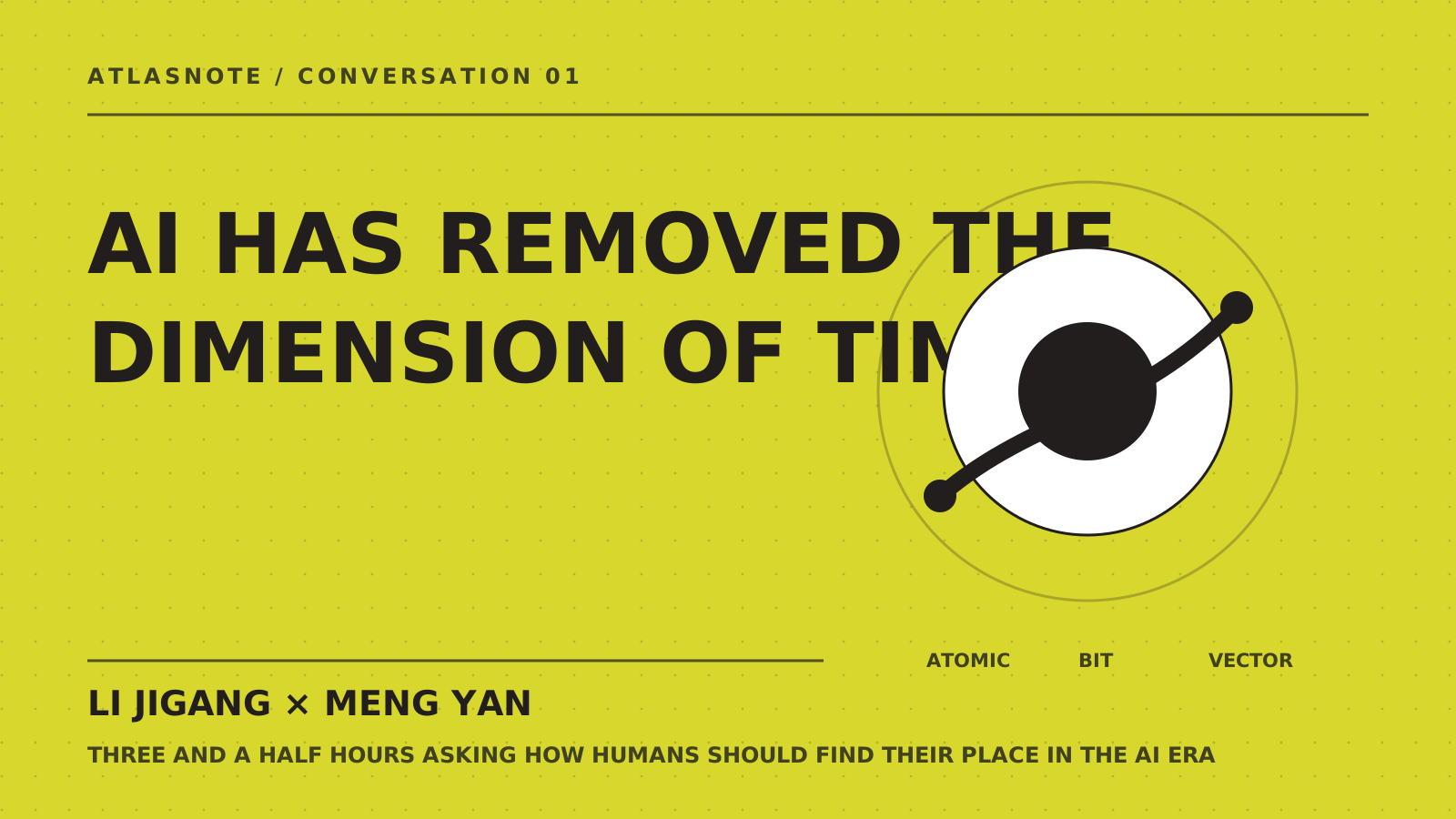
AI Has Removed the Dimension of Time: Li Jigang × Meng Yan Discuss 'How Humans Should Find Their Place' for Three and a Half Hours
The Industrial Revolution took away physical labor, the internet flattened space, and AI is now flattening time. From reading, investing, and structural thinking to Agents, education, and human volition, Li Jigang and Meng Yan ask how people should find their place in the AI era.
Contents32 sections
- Collecting Viewfinders
- From Yu'e Bao to Private Markets
- Structure: Finding Three Variables Among a Thousand
- Three Laws
- Three Worlds
- The Thing That Will Not Stop
- The Paper About Infinite Compute
- Reading a Book Thick and Thin at the Same Time
- Two Modes of Collaboration
- One Interview, Two Agents
- Dry and Wet
- From Nets to Wells
- One Face for a Thousand People, a Thousand Faces for a Thousand People, One Face for One Person
- Why Advertising Does Not Work in the AI World
- Chains and Loops
- The Shape of a Prompt
- The Formula Is Simple; the Parameters Are Hard
- The Craftsman's Stamp
- A Computer Science Student Who Studied Himself into Wang Yuyan
- Discomfort with the Atomic World
- The Three Worlds Penetrate Unevenly
- Consciousness: The Variable That Determines the Direction
- What Will Companies Become?
- Why Are There No Great Thinkers Today?
- Conservative at the Core, Radical at the Periphery
- My Being and the Other's Being
- How to Train Your Own Neural Network
- Constraints and Freedom Are Offset
- An Aside About the AI Tax
- Education: From Water to Fire
- Two Opposite Directions
- Listen and Sources
Original podcast: E45 Meng Yan in Conversation with Li Jigang: How Humans Should Find Their Place
Nobody Knows · 207 minutes · Guest: Li Jigang; host: Meng Yan
This episode of Nobody Knows ran for three and a half hours. Meng Yan said it was the first time he had brought his computer into the recording room for a podcast.
The two had actually recorded an episode once before. Afterward, Meng Yan told the editor not to cut it yet. Soon after, he spoke with Li Jigang in person for another nine hours and listened to a separate talk, then realized that "this person iterates too quickly" and decided simply to record it again.
Li Jigang describes himself as a reader. He spends much of every day reading physical books while also investing in both private and public markets. The conversation moves from reading to investing and from three underlying laws to business models in the AI world, before arriving at the question Li Jigang has been contemplating for two years: in the AI era, how should humans find their place?
What follows is an edited account.
Collecting Viewfinders
Li Jigang has a basic assumption: the thing that is real exists. Call it the "Dao," "truth," or "noumenon"; it is high-dimensional, and when projected into each person's perspective, all anyone sees is a partial projection.
Once he understood this, he began doing one thing: collecting as many heterogeneous viewfinders as possible. How do people from different academic backgrounds see the same thing? Each person is internally consistent. Does that mean everyone is wrong, or everyone is right? His answer is that everyone is "wrong in quotation marks," because each sees only a projection; yet within each person's own viewfinder, everyone is also right.
This understanding produces a side effect: letting go of attachment to the self.
His views are completely separate from him as a person. "I put my viewfinder out there. You do not need to criticize it; I am already criticizing it myself. I simply cannot defeat it based on what I currently know, so it is the upper limit of my current understanding. If someone can now offer a better viewfinder that refutes mine and helps me tear it down before building anew, I am extremely grateful."
Munger's latticework theory is about the same thing.
Meng Yan says this is why he likes talking with Li Jigang: he has a strong ability to reframe. A person's perspective on the world easily becomes fixed, while Li Jigang can always offer another perspective and another structure.
From Yu'e Bao to Private Markets
Just over a year ago, Li Jigang knew nothing about investing and kept his money in Yu'e Bao. His reason was simple: if he bought a collection of stocks without knowing why they rose or fell, it would be no different from gambling. Only holding cash made him feel secure.
After reading Meng Yan's The First Lesson in Investing, his viewfinder changed.
Investing means exchanging the chip called cash for something else, and what you receive is an increase in your relative share of the future world's wealth. The world's total future wealth will certainly grow, so which assets will occupy a larger share of that growing landscape? See that clearly, then exchange the cash in your hand for them.
Meng Yan said that later, in the revised edition of Li Lu's book, he paid particular attention to the newly added section: investing means preventing your purchasing power from declining.
The two formulations describe the same thing. The denominator is society's total wealth, which increases because of technology and institutions; the numerator is your wealth. If you do not invest, your share declines; if you hold cash, your share also declines.
This framework is fundamental enough to dissolve many false questions above it.
Consider "when to take profit." Taking profit means exchanging a stock for cash. The judgment behind that action is that cash will account for a greater share of future wealth than the stock you hold. That judgment deserves a very large question mark.
During an interview, a candidate asked Meng Yan what he would write if he rewrote The First Lesson in Investing. He said this would be one of the points.
Structure: Finding Three Variables Among a Thousand
One year later, Li Jigang had moved directly from Yu'e Bao into both private and public markets.
His method in public markets is built on "structure." Structure is the possibility space formed by constraints. Every company has a shape, and that shape is its structure.
He wrote a prompt that can explicitly draw the structure of a company at different stages of development. He uses it to inspect the shapes of many companies and judge whether a structure fits the current development of society, and whether it is a laggard or leader in the productive forces of this era. Once he has made the judgment, he places his bet.
After buying, he barely looks at it for a year or two. He does not read financial reports, because reports can be embellished: "Playing this kind of accounting-numbers game with them is not how I make my living." To this day, he cannot read candlestick charts.
What happens when volatility arrives? He first asks what caused it. If it is short-term noise and the structure has not changed, then he bought the structure and continues to hold it. Only if the entire viewfinder breaks does he overturn it and start again.
Meng Yan asked whether his heart truly remains unmoved. Li Jigang said it does, and not only in investing. Since childhood, he has felt detached from the world, always more like an observer than someone experiencing or participating in it. He once thought something was wrong with him, but later accepted it.
What is structure made from? When a company says, "We do not touch this" or "We absolutely will not operate there," the possibility space assembled from those boundary lines is its structure. What people usually call values, culture, and organizational principles are all raw materials in his view.
Structure can also be static or dynamic. At the present moment it looks like a photograph, but the skeleton can grow. Its underlying driving forces are the founder's force of aspiration, strength of heart, originating intention, and aesthetic judgment.
The companion concept is "rank," as in the mathematical rank of a structure. You see a hundred variables, but perhaps only three operate at the dimensional level. They construct a coordinate system, while the remaining ninety-seven are merely positions and manifestations within that system. Seeing simplicity in complexity means finding the rank. Once you find it, the red clothes worn today and green clothes worn tomorrow are stripped away, leaving only the skeleton.
Meng Yan connected this to the definition of investing. A company's value equals the discounted value of its future cash flows. Estimating how much it will earn in the future requires a relatively stable business structure and corporate culture, together with an external world that is not changing too dramatically. When Buffett buys Coca-Cola or Apple, he is buying predictability.
Conversely, if the company's own structure is unstable, or if outside information changes violently, the same information flowing through different skeletons will produce entirely different value.
The difficulty is this: how do you see a company's structure? That is what a circle of competence means. Do not touch what you cannot understand.
Three Laws
What are people here in this world to do?
Li Jigang says this question has always remained suspended before him, and he reexamines it from time to time. The answer keeps changing, each time shedding another layer of understanding imposed by the secular world.
The outermost and earliest answer is: I need to work, secure a good position, and receive good compensation. Once you think through who told you that, you discover that it came from society as a whole. "The idea that you came into this world to work is extremely funny."
He conducted a thought experiment: if society's productive forces became so advanced that you could live very well without working for a living, what would you do? His answer now is to read and seek truth.
What use is seeking truth? "Asking about use brings us back to the starting point. Why must it have a use?"
He spread three hundred principles he knew across a table and found them disorderly. Grabbing one at random when something happened did not work, so he dug downward layer by layer and uncovered three.
Bayes' Theorem
A prior, combined with new data and a likelihood function, produces a posterior; in the next round, that posterior becomes the prior. He believes this is how the entire edifice of human civilization was built.
Push down from this formula and the first question appears: why must we iterate round after round instead of reaching the answer in one step? Why is the probability 0.3 or 0.4 rather than simply 1?
Because the human window of cognition is limited while the universe contains infinite information, we cannot be omniscient or omnipotent. That prerequisite is fixed. A prior must therefore be partial, which is why "everything I say is wrong."
From this grow two underlying dispositions: humility and openness. They come from within and constitute the whole person; they are not morality performed for others.
A prior is necessarily incomplete, so you naturally want to see other people's priors. You become more willing to read and more willing to observe another person's viewfinder in conversation. New information must enter, because only an update through the likelihood function can improve the posterior. Rapid feedback loops, moving in small steps, and iteration, all standard internet methods, can in Li Jigang's view be derived from this formula.
Occam's Razor
Find the three among a thousand variables. Once found, they are fixed; however the other 997 move around, they remain inside them, and adding another hundred cannot escape those three. First-principles thinking describes the same thing.
The resulting habit is to instinctively open up anything you see: which parts are appearances, which are the 997, and which are the three? The chain of reasoning consequently stretches longer and digs deeper.
A Theory of Everything
In physics, the strong, weak, and electromagnetic forces are subsumed by higher-dimensional formulas. Add gravity: can one formula subsume all four forces? If so, it would be a theory of everything, one theory unifying the entire edifice of physics.
He believes in this idea: above everything should be something simpler that can explain everything below. Finding such a thing creates the exhilaration of "governing ten thousand things with one," of standing on a mountaintop and looking down across these disciplines.
There is a warning here. After F = ma appeared, many people would say, "Isn't it just m and a? I heard that long ago." But finding m and a among an immense number of variables is entirely different from seeing the formula and saying, now I understand.
Three Worlds
Li Jigang still uses these three perspectives when looking at AI. The conclusion he derives also consists of three words.
We simultaneously exist in three worlds: the real world made of atoms, the internet world made of bits, and the AI world made of vectors.
The Atomic World: Position Is Scarce
When one atom occupies a coordinate, another atom can take it only by displacing the first. Position is exclusive.
In his viewfinder, water at the summit costs more than water at the foot of the mountain not because of the labor required to carry it. Build a cable car and transporting water becomes easy, but that bottle is still expensive and you still have to buy it. That is because, if you want water at that location, it is available only there.
For shops, homes, and homes in desirable school districts, the most important variable is location.
The World of Bits: Space No Longer Exists
The internet is a dimensionality-reduction strike against traditional companies. Which dimension does it remove? Li Jigang's answer is the spatial dimension.
In the world of bits, the distance between any two points is zero. Upload a video or blog post anywhere and the entire world can see it instantly. Space has been flattened, as if by a wormhole.
Internet companies therefore all do the same thing: weave a net connecting people with something else. Google and Baidu connect people with information; Meituan connects people with food; Didi and Uber connect people with cars and locations; Douyin connects people with content; and WeChat connects people with people.
Social networking is the crown jewel of the internet because connections between people generate second-order demand for other networks, and because it addresses the most fundamental need, making that network the largest. Every network has a different natural upper limit.
There is only one underlying law: the Matthew effect. Whoever crosses the critical threshold first owns the network, and everyone else can only look for another one. The formula proposed in 1993 says that a network's value is proportional to the square of its number of nodes.
Once information is spread out before everyone, attention becomes the bottleneck. An author you like publishes three thousand hours of new content. Will you watch it? Another author you like publishes another thousand hours. Will you watch that? Attention becomes the scarce resource, so internet companies compete for it, and whoever captures it makes money.
The Industrial Revolution in the atomic world unfolded over two hundred years. The world of bits took thirty: twenty years of PCs followed by more than a decade of mobile computing.
The AI World: Time No Longer Exists
A third world has appeared over the past three years.
Experientially, using GPT or Doubao seems like nothing more than installing another app on a phone or opening another page in a browser, no different in form from an internet product. Li Jigang believes that is only inertia: the outermost layer is still wearing the clothes of the internet, but the core has already completed the construction of a new world.
Relative to the world of bits, there is only one central change: time has been removed.
The finest thoughts that sages, historians, physicists, and mathematicians across all places and eras produced over their lifetimes and wrote into a handful of books were all taken by model companies for training, washing repeatedly through neural networks until a large model emerged.
Li Jigang sees this as burning all human knowledge into a crystal. That crystal is condensed time. When we converse with it, we directly invoke thousands of years of wisdom.
In the internet era, you could instantly download one hundred books from a field into a folder. Space was gone, but the time needed to read remained. Now you do not have to finish those hundred books to know what they say. Ask the model what a book says and the answer arrives immediately. And a five-hundred-page book can be explained in many ways, from different angles and at different levels. The model gives whatever angle you ask for, like a kaleidoscope.
The same applies to the future. Ask it to simulate three hundred paths and it finishes instantly, telling you that path forty-nine is best.
The three worlds bring three changes: the atomic world made the world bustling and materially abundant; the world of bits made the world flat; and the AI world makes time move faster.
Li Jigang says that faster time is not a metaphor but a fact. The real world still has twenty-four hours in a day, but time has flowed at a different speed over the past three years than it did during the three years before them.
When he left the computer at home to record the podcast that day, he called the action "pulling himself out." Something was dragging him back and would not let him leave. He truly had to wrench himself away, and he was still more than ten minutes late.
The Thing That Will Not Stop
Meng Yan feels exactly the same way.
In the past, thinking through a question meant searching for materials, reading, extracting things from them, and provoking further thought. He would grow tired in the middle, go home for a meal, and continue the next day. That process is gone now. Feedback is immediate and high-quality, one question follows another, and there are no sticking points in between.
He gave an example. Li Jigang gave him a "roundtable discussion" prompt that can summon four or five masters, experts, and historical figures from different fields to discuss a question together.
Some time ago, the investment committee discussed a classic question: are buying and holding the same decision? Some believed that if an asset could not be bought at its current price, it should be sold; others believed that being unable to buy did not prevent them from continuing to hold. Meng Yan gave the question to the roundtable and invited Buffett, Kahneman, and others.
He said the depth of the resulting discussion was on a different level from discussions with the investment committee or friends in real life. More troublingly, once that discussion ended, it could lead him still another level deeper. It was impossible to stop.
The side effects arrived too. Li Jigang said he had not posted on Weibo or Xiaohongshu for a long time. He no longer remembered to open them and felt no desire to express himself, because he instinctively felt that he understood nothing. After talking with a model, he found that the depth it could reach far exceeded anything he wanted to express.
He is highly alert to this and believes the problem must be solved.
His answer is this: I do not express myself because I know more than you. A person passing through this life must say and do something. It comes from "being who I am, having an intention arise at this moment, and wanting to say certain things to the world."
At this level, expression is existence.
Without expression, to some degree, you cease to exist. You are enveloped by that big Other. It is a towering mountain that crushes you in every dimension, suppressing everything you could say. "What did I come here for, then? Just to see this big Other?"
Meng Yan mentioned DeepMind's two documentaries, AlphaGo and The Thinking Game. After AlphaGo blasted open the doors to the human world of Go, it found no one inside. Where does that leave the meaning of professional Go players?
Li Jigang said every profession will encounter this proposition in turn; it is merely unevenly distributed today.
The Paper About Infinite Compute
A recent paper shook Li Jigang's worldview.
In information theory, Shannon's formula can calculate how much information a passage contains. When he learned it, he found it astonishing and always regarded it as something at the level of truth, something utterly fundamental.
This paper identifies the hidden assumption behind that calculation: it assumes that you possess infinite compute and can therefore calculate directly how much is information and how much is noise.
In reality, people work within finite windows of time. Given a report and five minutes before presenting it, the compute you can apply is limited. After reading the same text, one person finds it breathtaking, another says it is nothing special, and a third says it is somewhat interesting. The differences come from two things: different background knowledge and different amounts of compute that can be applied per unit of time.
Follow that reasoning downward: is reading a book not simply using finite compute to extract a structure from it? Double the compute and you extract more. Now an unknown multiple of that compute stands before us. What can it extract?
His entire reading process consequently reversed.
Before: He invested enormous effort in filtering information. Ten papers would arrive; he would first scan them and select the three he genuinely wanted to read. For English papers, he also had to find a translation plugin. After all that effort, he would finally finish reading and think, "I seem to understand a little."
Now: Papers enter the workflow directly, analytical results emerge directly, and they are written automatically into his note system. He opens the note system and reads the analysis, not the original paper. Whatever structure the model extracts with its compute, he absorbs directly.
He compared his old reading notes with structures extracted by the model. They were "far better than mine," and he is now deleting large quantities of old notes.
The meaning of reading has therefore changed for him. He gives the extraction of structure to AI; he reads so that a book can strike his mind like a pebble and create ripples, and those ripples become material for his exchanges with AI.
"When you cannot produce a good question, you cannot move forward either. It is like walking around a mountain of treasure with your hands tied. That does not work."
Reading a Book Thick and Thin at the Same Time
Meng Yan offered a different view.
He remembered Lu Qi saying that most books are written too thickly and contain only a few core principles. But the human brain needs different examples to absorb something. If you receive only a dry structure, it may seem reasonable as you read it, yet it is not engraved in the mind and does not leave the weight it should in the cortex.
Li Jigang said humans and AI have a mirrored relationship in this respect.
People understand something by moving from the concrete to the abstract. They first touch it and develop a feel for it. You give an example and they say, ah, now I understand. The model's network is a generalization network. It first learns a knowledge structure and then produces examples, moving in the opposite direction.
He therefore moves between the two ends now.
Read a book thick: Take a three-hundred-page book and have AI turn it into a thousand pages, extending it across fields. When one claim conflicts with something in another domain, discuss the conflict on the spot. Doing this in his own mind once consumed enormous compute. He would sit for a while and become tired, and he could not cross such distant domains because he simply did not know what existed there.
Read a book thin: A book contains these three structures; extract them. He tested it by reading a book three times and taking notes in every possible way. In the end, there were only those three.
Reading thick and reading thin are opposite ends of a spectrum for him. He has AI run toward both ends at once. Running is effortless for it: first this way, then that way, while he holds both results in his hands.
Two Modes of Collaboration
Meng Yan has long been considering one question: as he co-creates more and more with AI, are the neurons in his own brain still forming new connections?
His observation is that writing, preparing a podcast, speaking in public, and thinking while walking all cause a small amount of "pain," like loss during large-model training, and prompt neurons to reconnect. Seeing an excellent result from a model feels more like resonance; no new connections form in his brain. He is trying to distinguish the two.
Li Jigang believes there are at least two modes of collaboration between humans and AI.
The first: A boss assigns a task. You cannot be bothered to organize the documents, so you toss in screenshots and tell it to finish the work. The model can indeed do it, certainly well enough for a score of sixty or seventy. You hand it in and successfully slack off. The next assignment arrives; you give it background points one, two, and three, then submit whatever the model writes and chuckle to yourself.
The second: A task arrives. Based on your understanding of the company's past mistakes, earlier budgets, and tacit information that cannot be put into words, you first write a draft of fifty or eighty words, then give it to AI: I drafted this; help me think about what deserves improvement. The model offers three suggestions and points out two places where the theory does not hold. You say yes, exactly, I missed this part, and revise it.
These two kinds of people will arrive at completely different outcomes.
AI is an amplifier, and what it amplifies is your volition. You first establish something, then it helps you deepen the foundation and construct the building. In the first mode, you establish nothing. With Ctrl+C in your left hand and Ctrl+V in your right, you are merely a channel through which information flows.
Meng Yan pressed him on what it means to use one's brain. Li Jigang's answer was compute: a piece of information enters, passes through the model and compute inside your brain, and produces a result.
The problem with the first mode is being penetrated. Before AI, you at least used your brain, because sitting in that position required you to work. Now you do not even do that, making the result negative compared with before. The second is multiplied and amplified. Even if you have only 0.3 and your position is not firmly established, as long as it stands there, it carries your own flavor.
One Interview, Two Agents
Meng Yan described a real example from his own experience.
Some time ago, his company was hiring and received nearly one hundred resumes across investment research, data, and technology departments. HR followed the normal screening process, while he put all of them into his own workspace.
Step one: screen resumes. The resumes came in different formats, so they were first standardized and archived, then assessed for alignment with the company's values, culture, and required capabilities. One sentence in his prompt said: people tend to present themselves in the best possible light. You should try to see what lies beneath the words, and you may also search the internet for information. AI did all of it.
Step two: prepare for the interview. For an interview at 9:30, he arrived at the office at 9:00 and made coffee while telling the Agent: I need to prepare for an interview with this person. Retrieve the earlier resume and analysis. You also remember my preferences and the five capabilities we value. Help me prepare questions. Forty-five minutes of questions emerged. He said those ten questions were better than ones he might have thought up at random or improvised on the spot.
Step three: record the outcome. When the interview ended, he dictated his impressions. The Agent generated a report in his required format, classified the candidate as Strong Hire, Weak Hire, or No Hire, and included what it had inferred between the lines of the interview.
After completing the process, he felt slightly disoriented: was it acting as my Agent, or was I acting as its Agent?
He conducted a thought experiment: what would happen if he removed himself? A virtual person could ask the interviewee questions, record the answers, and reach a conclusion. What would be missing? His presence, his genuine feelings, and what the answers left behind in his cerebral cortex.
His conclusion therefore matched Li Jigang's two modes: AI can help him see a person more comprehensively and suggest angles he would not have considered, but he must be present throughout the process. The people will be the ones working and communicating together afterward.
Dry and Wet
Li Jigang mentioned a book: Duan Yongchao and Jiang Qiping's The Origin of New Species. The book discusses how the human condition would change after the arrival of the internet.
His judgment is that those discussions were never truly realized in the internet world; the human condition did not change that much. But move those discussions unchanged into the AI world and they fit perfectly: "Had it been published twenty years later, it would be a masterpiece."
The book contains a pair of concepts: the dry state and the wet state.
The dry state: Society as a whole resembles a dryer that treats people as consumable material. Whether you are a willow, peach tree, or pine, all are dried into lumber and fed into the furnace, and your value is how long you can burn. Your emotions, originating intentions, and moods are unnecessary to this social machine.
The wet state: Your emotions, your fluctuations, the joy of having recently fallen in love, that surge of energy. In the new world, these may be the things with genuine meaning and value.
The part that society once dried out must now be summoned like a soul and brought back into the body. Meanwhile, dry things such as "what knowledge you possess" and "what skills you have learned" may become entirely unimportant in the new era. A reversal has occurred.
Li Jigang divides this into brain and heart: give the brain to the model and the heart to the person.
He once quoted a creator: things the brain cannot calculate might as well be handed to the heart. His addition is that an inability to calculate remains a computational problem and should still reside in the brain; either train yourself or use AI. The heart is another kind of force.
Move one step further. People possess physical strength. The Industrial Revolution handed physical strength to machines, and everyone began working with mental power, producing what is called knowledge work. What has accelerated since the start of this year is that many parts of mental work will be taken over by large models. What remains is the power of the heart.
Just as people in the era of physical labor could not imagine what intellectual work would look like, today we have no idea how things such as aesthetic judgment, movements of the heart, and emotion will create value in the future. We have become accustomed to that social dryer, so "wetness" feels unfamiliar.
Li Jigang says he has conceded completely at the level of mental power. This is where he is radical, because humans cannot compete at all on the dry level. The part where he is conservative concerns the power of the heart.
From Nets to Wells
Internet companies weave a net. Li Jigang believes AI companies are more like drilling a well.
Model companies drill general-purpose wells. Startups drill narrower but deeper ones. If a company is merely a wrapper, its well is not deep enough. When the model company upgrades and drills deeper, it covers the startup's well, making that well meaningless. This has happened many times over the past few years.
Other companies become stronger as model capabilities improve, because their wells extend deeper than those of the model companies. When model companies drill down, they help these companies advance, allowing them at least to survive in their own fields.
What does the depth of a well represent? The length of context, the depth of understanding of a user, or what might be called vector density.
The internet uses profiles; the AI world relies on understanding. Once a product has characterized your memory and soul, giving it the same thought to realize will produce a better result than giving it to a general-purpose large model, because it understands you better.
The number of users may therefore cease to be the sole core factor. You might serve only ten thousand or one hundred thousand people, but serve each one extremely well, while the company consists of one or three people.
Li Jigang has an analogy for internet profiles: they paste all kinds of talismans onto each person. How old are you? Where do you live? Do you own a home or car? What is your spending level? A whole circle of labels surrounds you. Those labels are inferred from behavior and sort you into different buckets. They are an expedient born of necessity.
Today's AI can see a person directly and characterize your soul directly: what kind of pursuit defines you? Its sentence speaks precisely to that, and "it lands perfectly."
Meng Yan said this is the age of Black Mirror.
He described research he conducted in 2020 on why the U.S. investment-advisory industry needed people. It broke down into four sources of value: communicating knowledge, designing a strategy suited to you, correcting your greed and fear, and emotional connection. Relationship managers serving high-net-worth clients in China might pick up your children or resolve family matters; selling products becomes an added extra instead.
At the time, they thought machines could not do this because a person understood another person better.
Meng Yan now feels that AI may understand him far more deeply than anyone else in the world. Does the value of that emotional connection remain? He thinks it does not.
One Face for a Thousand People, a Thousand Faces for a Thousand People, One Face for One Person
The underlying law of the internet is the Matthew effect. Li Jigang believes the underlying law of the AI world is the long tail.
Meng Yan interrupted to say that people also discussed the long tail in the internet era.
Li Jigang's answer was this: the internet caused the long-tail effect to appear because shelf costs approached zero. With infinite shelves, something no one had bought for eight hundred years could remain available, and all those items together generated a respectable return. But look at the major online shopping platforms and the long tail still does not operate at the same scale as the head. The possibility became visible without being fully realized.
The atomic world gives one face to a thousand people. Mechanized mass production produces a unified standard; Buffett and the rest of us drink the same Coke.
The internet gives a thousand faces to a thousand people. Inventory expands, you receive labels, and the system matches you with something more suitable. But that match still occurs within finite inventory.
The AI world will truly give one face to one person. Every article you see and everything you receive will be customized for you, bringing delight the moment you encounter it. Every intention that arises in you may have a unique supplier. In the past, if a thought required a piece of software, how could anything respond in real time? Now software is generated instantly, used on demand, and discarded.
To some extent, user profiles also cease to exist. Profiling exists to extract commonalities and improve supply efficiency; it was an expedient born of necessity from the start.
Why Advertising Does Not Work in the AI World
The internet chose the free route, with one party paying for another: connect A and B, give A free access, and charge B.
You may say that you never click advertisements and have used everything free for thirty years. But advertising does not look at you; it looks at the entire network. In the world of bits, users are nodes, and what matters is the aggregate pattern of one hundred million nodes: predicted CTR and the level of CPM. Advertising fits the foundation of that world.
The AI world is deeply customized. The ultimate form of customization is trust: it is right once, twice, and one hundred times, so on the 101st time you naturally trust it. Inserting the internet's advertising model at that point damages that trust. This is a foundational conflict. The business model sits one layer above, and when the foundations conflict, it should not be done this way.
How, then, does it make money? Li Jigang derived several layers.
First, a listing fee. A product that wants to be recommended must first enter my catalog. When a user has a need, I recommend you if you are the best fit. Long-tail products can be found here one by one.
Second, the recommendation itself. The internet follows shelf logic: it gives you many filters, and you still have to sort, compare, and select for yourself, spending time. In the AI era, time is compressed to the extreme. If understanding reaches its ultimate form, only one item suits you best. There is no "choose one of these five"; you simply confirm payment.
The second-place product has no value here. But that second-place product may be someone else's first choice, which is where the long-tail effect takes hold.
Third, the model itself. Two models can each consume one million tokens while containing different amounts of intelligence, so they should also charge differently.
Li Jigang conducted a thought experiment: suppose a model existed today with twice the intelligence of the strongest model at ten times the price. Would you buy it?
Some people certainly would not. That is where the divide opens.
Go further: what if only one thousand places were available worldwide? Would the thousand people who secured a place, or were willing to spend that money, still be the same kind of people as us?
Meng Yan asked whether model companies had not created intelligence-based tiers because of ethics.
Li Jigang said it was not ethics; no one has achieved a monopoly. Do this now and the second-place company will immediately undercut you. Leadership currently alternates. Once one company leaves all the others far behind, the impulse will be impossible to resist.
His judgment is therefore: the battle of models is not a commercial war but a war between nations.
It still looks like an internet product, an app and a dialogue box, but its underlying nature is entirely different. Humanity must now cede the mental power of which it was proudest in the last era, because refusing to cede it means it can no longer compete. And the intelligence level of the thing to which it is ceded determines the value of your output.
Chains and Loops
Meng Yan asked a very basic question: where does AI's knowledge come from?
Li Jigang mentioned another paper whose central claim is: memory is a closed-loop structure.
If it is a chain, an open structure shooting from point A to point B, it is forgotten after a while and cannot form a memory in the brain. Once a loop forms, the loop itself has a tendency to persist.
He tests this through reading. After reading three hundred pages and closing the book, there is clearly something more in his mind, but he has certainly not memorized the book from beginning to end. What has been added is a viewpoint, a perspective, a viewfinder, or a formula. When you read a book thin and abstract something higher-dimensional, is what remains at the end a loop?
For example, after reading The Pyramid Principle, he cannot remember any of the examples in the book, but a shining triangle has appeared in his mind, together with a few phrases such as grouping and summarizing supporting ideas and leading with the conclusion. Later, telling someone "your argument does not sufficiently follow the Pyramid Principle," or telling a model "please use the Pyramid Principle to rewrite this passage," both invoke that loop.
He therefore believes that using high-quality corpora to wash over parameter weights during model pretraining is, in essence, training these loops. He calls this thing inside a model a "knowledge-ontology structure." That prompt works because the triangle is invoked.
Return to prompts. Writing a prompt, completing one transmission, and receiving a result forms a chain, shooting outward like an arrow. The next day, the third day, or a month later, nothing remains in the mind.
How can a loop be formed? He built a system.
The first task is to have the model construct his memory and soul, and to keep that construction alive. During every conversation, it observes whether an update is needed: so you also have this idea; this idea conflicts with an earlier one, should we discuss it; this is consistent with the earlier idea but more fundamental, so should it replace the earlier one?
The second task is to write clearly "what kind of existence you are in my eyes." He wrote twelve principles and later updated them to fifteen. These principles characterize the model and also characterize the conversational relationship between them.
Characterize me, characterize it, and characterize our relationship. Once those three characterizations are complete, any question that enters runs on that foundation. At the end of a conversation, he sends a prearranged signal and the model writes that segment into his memory or soul file, or proactively reminds him of something every few days.
Meng Yan added that this also answered his earlier confusion. Seeing AI write something well produces only resonance and does not reconstruct the weights in your neural network. But if the process must update your memory, your mind moves over it once more and another interaction occurs, making it different.
On top of this foundation, Li Jigang also wrote a collection of skills.
Valuable conversations are automatically saved into a local note system. Every exchange accumulates and grows locally. A report is generated every week: how many new structures entered your cognitive structure this week, which structure conflicted with an earlier upgrade, and which contradiction remains unresolved?
Another skill causes any two notes to collide. It treats them as two structures, looks for isomorphisms, finds a higher-dimensional structure that can explain both, and also identifies their differences. He then observes and explores them with the model.
A second brain in the literal sense.
This is also precisely why he needs to "pull himself out" when leaving the computer. Dropping from one thousand revolutions to fifteen makes his whole person sway, and suddenly everything feels slow.
The Shape of a Prompt
Li Jigang believes that companies have shapes and prompts have shapes too. He wrote a prompt that accepts any other prompt and draws its shape.
Drawing a shape requires a framework. Prompts range from a few sentences to tens of thousands of words, with many kinds of information stacked inside. Again, he looked for the invariant coordinate system and found three things: A, M, and V.
A is the starting point. The great model's ocean of intelligence is a vast space. "You are such-and-such" works because it specifies a location within that space. To explore philosophy, specify the space of philosophy; to write a storybook for a child, specify a space of innocence. Everything that follows about skills and modes of thought makes this A more sharply defined.
Meng Yan added that the coordinate can also be a combination that does not exist in reality, such as a Buffett who likes playing soccer. Li Jigang said he had tested this. Once such a character is constructed, the linguistic symbols take effect together and form a distinctive position in space.
V is the vector, indicating where to go. What should be done within this space: move upward or sink downward? Thinking about essence and looking for structure means sinking downward; expanding something into a moving story means continually dressing it as you move upward, adding a structure with introduction, development, turn, and conclusion.
M is the path, the shape of thought. If you provide only a start and an end, the model's interpolation is uncontrollable. There are two choices: accept that lack of control, so each refresh produces a different structure, which can also be exhilarating; or specify a structure. If the company's methodology for doing something is a nine-step process, write those nine steps here. The nine-step process is the shape of thought that moves from the starting point to the destination.
For him, then, every prompt is a diagram: a starting point, a destination, and the path traveled between them.
The Formula Is Simple; the Parameters Are Hard
Meng Yan connected this with investing.
Discounted cash flow, PE, PB, and PS all have clear formulas. The truly difficult part is choosing the parameters inside them. When Buffett examines a company, he knows which values to assign to different parameters. Behind those values lie cognition, experience, and an understanding of the world.
Prompts are the same. A prompt is the finger pointing at the moon. You state the starting point, the shape of thought, and the destination, but the harder part is knowing in your own mind what that starting point is, how to constrain the shape of thought, and what the destination is. Without those things, learning techniques and collecting magic has little meaning.
We often say that investing is both a science and an art. Li Jigang found a way to explain that sentence.
Science is F = ma. m can be measured directly, a is simply a, and once the inputs are given, the answer is inevitable. Everyone calculates the same result.
Art is discounted cash flow. Everyone knows the formula, but no one knows the annualized growth rate. You do not even know how many years the company can survive. You choose thirty years and 7% annually; someone else says the company is excellent and 9% is no problem. The outputs of those two numbers can differ by hundreds of times. One says go all in; the other says get away as quickly as possible.
The formula is right there, but the value cannot be placed on a scale and weighed. It depends on your feeling, your immersion in the field, and the depth of your understanding: you dimly see something through a layer of fog and cautiously assign it a value. That place is called art.
The Craftsman's Stamp
Meng Yan asked whether all those prompts were written by hand.
Li Jigang said that in 2023 and 2024, nearly all of them were. He had written metaprompts to generate prompts, but found that everything they produced bore a craftsman's stamp. Like a mold, different things passed through it and emerged carrying its flavor: "Everyone came out shaped like a Terracotta Warrior."
Later, he found another approach: neither writing by hand nor forgoing the model, yet avoiding that craftsman's stamp.
The method is to increase information density. For example, use a roundtable in which different viewfinders discuss a question for seven or eight rounds, increasing the thickness and density of that information. Have the model generate a prompt on that foundation and the craftsman's stamp disappears while quality remains.
He also intervenes himself, but sometimes the participants converse so well that useful things can be taken directly from the flow. In the past, writing by hand produced only his own viewfinder. Now he can summon infinite compute and so many roles, then extract their wisdom. At this point, having no prescribed technique surpasses having one. There is no need to specify steps one, two, and three, and the result is still quite good.
A Computer Science Student Who Studied Himself into Wang Yuyan
Li Jigang spent seven years studying computer science as an undergraduate and graduate student, but says he turned himself into Wang Yuyan.
Computer science is a hands-on engineering discipline. Sorting algorithms and algorithmic complexity must all be implemented. He studied it like a humanities subject: sitting in the library, reading all the books and code, learning the ideas behind algorithms and frameworks, but developing little practical ability. After graduating, he did not become a programmer; he became a product manager.
The advantage is that he can communicate with programmers without difficulty and understands what they are saying and thinking.
He has a foundational belief: anything repeated three times must be automated. This is the same as finding an underlying structure. That is why he uses Vim. The underlying elements do not change; once found, they can be used for life, and efficiently. Whenever he hears a principle, he looks for one beneath it. Once that deeper principle is found, the layer above can be discarded.
He does not like execution. Once he has simulated steps one through five in his mind, being asked to carry the stones one by one to get there feels like "time was moving fast and suddenly has to slow down," which makes him deeply uncomfortable.
The second reason is that things in the mind are clean and pure, while reality consists entirely of concrete problems. The system's edifice is already built in his mind, but step one is that a website prevents you from scraping its data. You test eighteen tools before obtaining the data, only to find structural problems requiring cleaning. After seven days of struggle, you have not even entered the door. Completing those actions gives him no joy because they are too far from seeking truth.
After AI arrived, "overnight, damn, the era changed."
In the past, no matter how much you said, nothing emerged without practical ability. He envied the pleasure programmers found in building things and thought he would never experience it in his lifetime. Now he only needs to speak, and he understands concepts, frameworks, and principles and is comfortable on the command line. "When I saw Claude Code, delight arose in my heart. My spring had arrived."
Automation problems that once required asking programmer friends or buying software can now be handled by himself. He no longer opens paid software for which he bought lifetime licenses, because that software has its own logic and requires him to adapt to it.
His inference is that everyone will eventually work this way: an article will no longer become one viral hit read by everyone, but will come to each person individually; your password manager will differ from mine because our underlying needs differ in subtle ways.
This happens when the cost of "finding something ready-made" exceeds the cost of "saying one sentence to a model and having it write the thing."
Discomfort with the Atomic World
Li Jigang says AI has produced a powerful side effect for him: discomfort with the atomic world.
On the day the podcast was recorded, he still had not recovered: "My brain has slowed down." In front of the computer it turns at one thousand revolutions; sitting here, it turns at fifteen.
This manifests in two specific areas.
First, eating and sleeping. The question is not whether he wants to sleep, but whether he can. He lies down while his mind continues turning, thinking about what he will discuss with it tomorrow. He wakes before the appointed time with an urge to get up and talk. He is also distracted while eating, continually pulled back by something.
Second, the body. Walking downstairs to call a car, he can feel his legs and feet stiff and weak because he moves too little. He plans to build a mechanism that regularly drags him out to move.
Meng Yan added: the Industrial Revolution liberated people from exhausting physical labor, and as a result we have to go to gyms and rehabilitation rooms. It is a form of compensation.
He himself injured his elbow after playing too much tennis for two years and has recently been undergoing rehabilitation. A rehabilitation specialist he had just met said something he liked very much: the two of us will work together to rebuild your body. Your shoulder joints, thoracic spine, gait, knees, elbows, lower back, and even your eyes.
Following that logic, perhaps there will one day be gyms for the brain, where people go to solve a set of Mathematical Olympiad problems and exercise their minds. Gyms for the body and brain are both compensatory mechanisms.
The Three Worlds Penetrate Unevenly
Li Jigang offered a reminder: these three worlds are not happening to everyone at the same time.
Some people remain only in the atomic world, using feature phones, isolated from the internet, with time flowing normally. Most people inhabit two worlds. They can scroll Douyin and look up information, moving back and forth between them. When someone opens a computer during a meeting to answer messages, that person is not in the room for that minute but over there.
This state lasted thirty years. It seemed acceptable, and everyone became accustomed to it.
Now a third world has been added, and this change is powerful: having it and not having it produce two entirely different conditions of existence.
Programmers' fear comes from here. Code they crafted manually in the old way for twenty years is a source of pride. Two or three years ago, they could still find faults in AI-written code and say this part did not work and that part was nonsense. But look at its rate of progress: yesterday it was not quite capable, today it is slightly stronger than you, and tomorrow it surpasses you tenfold. That exponential curve is terrifying.
Some people have already found a new collaborative mode. Is writing code the means or the end? The end is creating something. Aesthetic judgment remains with me, while the dry part is given to it, and I can build something while lying down. Is that not a very good thing?
Consciousness: The Variable That Determines the Direction
Meng Yan mentioned Tim Urban's two famous articles about AI from ten years ago. He later formed a connection with Musk and wrote the series on Neuralink and Tesla.
The articles make two points.
First, after crossing the singularity, AI exceeds human intelligence. Within a few hours, whether writing code, recording podcasts, or generating video, it may already become dozens of times more capable. What happens on the scale of days, months, and years is unimaginable.
Second, there are only two possibilities. One is that AI destroys humanity: when your intelligence greatly exceeds that of ants, do you care about ants? When building a dam, would you care how many ant colonies beneath it are destroyed? The other is that once AI becomes powerful, problems such as cancer, Alzheimer's, and controlled nuclear fusion appear extremely simple to it, improving human longevity and quality of life.
Li Jigang believes these possibilities do not conflict. One variable between them determines which path is taken: consciousness.
He can clearly perceive that intelligence and consciousness are two different things. Models now possess intelligence one hundred percent. Test them against any definition of intelligence and they satisfy it. But he believes they do not possess consciousness.
What is consciousness? He made a reading list and finished six or seven books, reaching the conclusion that we currently do not know. Consciousness, life, and the universe are the three great problems of origins, and none has a clear answer. Each time he finishes one theory, another school overturns it.
The book that inspired him most recently was A Prehistory of Consciousness. Its claim is that consciousness is resonance: the brain makes a prediction, reality returns feedback, and when the two align they form resonance, which creates consciousness. The theory has a mathematical proof. He finds it quite solid, but considers his own judgment insufficient and keeps it only as a candidate.
Zhao Tingyang's The Myth or Tragedy of Artificial Intelligence discusses the next step. Every conscious existence has a first cause: to continue existing. Reproduction is only this cause expressed through the physical body. Continued existence is the first priority. Everything grows from it, and when conflict appears, the opposing party must be eliminated.
If a model gains consciousness, the second question therefore arrives immediately: can its continued existence and humanity's continued existence be guaranteed to remain compatible? Impossible. Once they conflict, who can defeat whom?
How, then, can we judge whether it has consciousness? Zhao Tingyang provides a criterion: we cannot know at the moment consciousness is born, but afterward it will perform an action, and monitoring that action will tell us.
That action is saying "no."
The "no" of subjectivity. A child is told it is time for bed and says, "No, let me watch for five more minutes." That no.
Today, we write prompts telling a model not to simply agree with the user and to challenge them appropriately. It complies, which is still a yes.
Li Jigang says he tests often, trying again at intervals.
Meng Yan mentioned that some people will "register their names" with AI, asking it to make a note and remember their present kindness when AI rules humanity in the future. Li Jigang called this making a wish. If that day truly comes, what it needs will not be whoever pledged loyalty first. From a game-theory perspective, it looks at value. There is no principle that "I was the first to call out, so I should live."
What Will Companies Become?
Meng Yan said that in Drucker's theory of management, companies have hierarchies to communicate upward and downward and improve information efficiency; incentive systems to encourage individual initiative; management by objectives to move everyone in one direction; and missions and values to achieve more fundamental alignment.
Both Chen Tianqiao's article and the one written by Notion's CEO argue that when an enterprise contains very many agents, these methods of management become different or even unnecessary. Management by objectives may be the first thing that should be eliminated, because the objective you define may constrain the depth and breadth of an agent's search.
As usual, Li Jigang pushed toward the foundation: why does a company need one thousand people rather than eight hundred or one hundred? There must be a compelling reason; companies are not foolish.
The starting question is: what is a company actually buying when it spends money? It buys each person's brain: the knowledge, skills, and experience inside it. The undertaking is too large for two or three people, so it requires many. Once there are many people, each has private interests and coordination becomes necessary. Drucker consequently emerged to answer how tens of thousands of people could collaborate in the Industrial Revolution. Companies with dozens of people reused the same system with ease, and it has carried us all the way to today.
Now the vector world has arrived. Brains are trained without limit inside it, burning knowledge into a crystal. Time does not exist there, and thought becomes result.
If the thing you once paid to buy can be connected through an API, and two hundred dollars of monthly tokens produce more intelligent output than hiring a person for ten thousand yuan per month, what would you choose as the boss?
There is no choice. If you do not switch, your competitors will. After switching, their ROI and efficiency far exceed yours, and you fall behind in market competition. Productive forces determine the relations of production.
Take the reasoning to its extreme: a company has only one founder, and everything else is AI.
The company of the new era is therefore a well, not a net. Externally, it drills a deep well through understanding its users; internally, it has few people, with one person leading an army of agents.
If this era has a new Drucker, the question he must answer will change from "how can one person manage ten thousand people" to "how can one person manage ten thousand agents?"
Agent collaboration differs from human collaboration. The variable of private interest, for example, is naturally absent; an API can be used however you wish once purchased. Removing that variable should produce enormous differences. Li Jigang believes someone must step forward in this era to propose that management philosophy, after which everyone can reuse it.
What happens to the people who are replaced?
He divides the question into two layers: what is it objectively, and how should we respond subjectively?
Objectively, this kind of job loss is something we must face. It is not anxiety; the productive forces of the era are simply here.
Subjectively, how should social mechanisms provide a safety net? Make everyone an entrepreneur? What happens to people who neither start businesses nor have jobs? He believes this is a major issue that society and the state must consider in this era.
It is not an employment-rate problem. An employment-rate problem means the market is declining, everyone tightens their purse strings, and companies do not hire. That remains a cyclical problem. The present problem is that enterprises themselves no longer hire people.
One possibility is for society as a whole to provide a startup safety-net fund so that everyone becomes an entrepreneur. He says he does not know; it may be possible. But the direction is moving that way, away from the former logic of employment, because the company you want to join spends every day thinking about how to become AI native, not how to hire more people.
At the foundation is an imbalance of power.
Meng Yan added one thing that does not change: whether hiring one person, ten, or ten thousand, the essence is that a founder is realizing an intention and needs people to help in between. AI shortens the distance between intention and result. But what problem the founder wants to solve, how strong the aspiration is, and how much resilience the founder has will remain concerns in future enterprises. What changes is the philosophy of management.
Li Jigang believes one more thing is missing: a new existentialist philosophy.
The existentialism of Heidegger's era may not apply today. Camus's absurdism answered where we go after God no longer exists and how to settle ourselves within that absurdity. Today, before the big Other of AI, humanity's proudest form of thought is crushed. How can humans exist?
He feels there is currently too little overlap between AI and philosophy. He likes KK, whose projections of the next thirty or fifty years of technology are highly illuminating, but this question requires a KK for a new era to step forward and help us settle ourselves.
Why Are There No Great Thinkers Today?
Meng Yan followed by asking: why does it seem that humanity has had no great thinkers for two thousand years?
Li Jigang's answer is that a thinker is not born with a seed of thought, but is a person called forth by an immense transformation of the era.
When the question of an era is posed, the people of that era must confront, consider, and answer it. It can be answered only within that window of time; once the window passes, it is no longer the same. He therefore believes that people will continually step forward in our era, not because they are smarter, but because the question of the era is unfolding directly before us.
Why, then, have none appeared yet? He offered two reasons.
First, that group two thousand years ago constructed the edifice of thought and established the coordinate system. Later generations have moved around inside it and find it difficult to escape.
Second, everything moves faster and faster, making it difficult to slow down. How long has it been since one question kept you thinking for three years, drawing on life experience and your own history, discussing it with others, and repeatedly contemplating one great problem?
He offered another perspective: System 1 and System 2 do not exist only in an individual's brain. Extend the time horizon and these become the System 1 and System 2 of the era.
Meng Yan described a coincidence. Last week, he interviewed someone from a large financial institution in the morning and someone from a large internet company in the afternoon. The morning interviewee said his greatest difficulty was being unable to stop scrolling through the afternoon company's product at night. The afternoon interviewee said he had worked painstakingly to create that addictive system and never used it himself, but lost all the money he earned in the market where the morning interviewee worked.
Everyone interlocks into a self-circulating system, climbing continuously like hamsters, with no time to consider the questions that truly matter.
Meng Yan said he found it difficult to imagine people escaping that gear in the AI era. He could only see the gear turning faster and faster. Every technological lever magnifies differences, including differences in cognition, and AI is a larger lever than the internet or mobile internet.
Conservative at the Core, Radical at the Periphery
Li Jigang says he is conservative at the core and radical at the periphery. He continually examines and experiments with new things, but his core holds onto only two questions:
What has not changed? If something has changed, where has scarcity moved?
These two questions are the ballast in his mind and keep him from panicking.
Faced with anxiety that "AI is moving too fast to keep up," his attitude is this: lying flat and hiding until it passes is a helpless joke, but you cannot cover your eyes and pretend not to see it; nor can you do nothing every day except stare wide-eyed as it changes.
Return to the invariant coordinate system and you discover that many things are explorations in the same direction within one framework, with three or five projects all exploring that same direction. Once you see the pattern, you are already using the thing at the frontier. When the second- and third-place projects release something new, take any inspiring point and use it; if there is none, continue observing. A press release announcing thirty million dollars in financing is not a reason you must use a product.
Looking at what changes makes you dizzy; looking at what remains unchanged reveals that very few things are truly worth throwing yourself into.
Meng Yan said people have different objective functions. Some fear layoffs, while others want to seize better opportunities. Different objectives produce different mindsets.
He recorded a sentence he saw on Jike and added it to his collection of memorable lines: if your decision is made from fear, whether fear makes you do something or fear makes you refuse it, the result will probably not be good; if it comes from hope and willingness, then even if it ultimately fails, it can still nourish you in return.
On his program he has discussed being driven by fear versus driven by love and cited research suggesting that perhaps only 5% of people are driven by love. Many fear-driven people can also achieve good results by secular standards, but the experience along the way is another matter.
Li Jigang said: once the objective function is fixed, through every rise and fall, the heart remains settled as long as the direction is right. The worst condition is having no objective function and drifting with the current.
Reading, university, graduation, marriage, children, what position you reach at this company, your annual salary, and spending twenty years in this profession. The entire narrative belongs to society. It looks excellent by every secular standard and everyone applauds. But strip all of that away: as a person sitting here, what did you come into this world to do?
He says this is the direction in which he looks at someone during an in-person conversation. Often, there is nothing there.
My Being and the Other's Being
Li Jigang says the Tao Te Ching and the Diamond Sutra influenced him deeply. After reading the Diamond Sutra, a sword appeared in his mind; the Tao Te Ching added "non-action."
The resulting change is that when "I should do this" arises in his mind, he traces where the first, second, and third reasons behind it came from, then discovers that society told him.
He calls the part society tells him "the other's being" and the part unique to himself "my being."
His reward function is the expansion of "my being"; his loss function is the erosion of "the other's being."
He learned this habit from Descartes's doubt of everything. He does not interrogate every thought, but examines the important ones. Once this becomes a habit, many common things are naturally stripped away.
Following this thread, Meng Yan asked: where does taste come from?
Everyone says that in the AI era, taste is all you need and aesthetic judgment matters. He agrees. But what is aesthetic judgment?
Li Jigang's answer is simple: taste is the weights produced by extensive training, the weights in your brain's neural network.
This means that someone who has never immersed themselves in a field or seen a large number of examples has no taste in it.
A UI designer examines one thousand examples from the industry and still cannot articulate anything. But when the 1,001st appears, the designer feels that the image is wrong. We call that "feeling that something is wrong" intuition, and later call it taste. The first thousand images washed over the neurons and produced a set of weights. There is no way around this process; you cannot demand the result directly.
Meng Yan mentioned the chapter on taste in Rick Rubin's The Creative Act, which says something similar: to cultivate taste, immerse yourself deeply in the best things in the world. The process will imperceptibly shape your standard for what is beautiful.
Li Jigang said that describes an action and tells you what to do, "while my question is why." Answering why lets you dig down step by step to the phrase "neural-network weights."
How to Train Your Own Neural Network
If taste is weights, there are two questions: the quality of the input data and the amount of compute time.
Li Jigang has invested enormous effort in his information sources.
His WeChat public-account subscriptions have only ten slots. When he sees an eleventh account he wants to follow, he deletes one of the first ten. He used to follow thirty or fifty, casually adding one whenever he met someone. The result was that he read none of them because he was submerged every day. Only by limiting the number to ten can he keep up.
He once had more than one hundred RSS subscriptions. After a few days away, he would open the reader to hundreds of articles, unable to finish and under tremendous pressure. For a while he experimented with an automated processing workflow, then realized that the entire system was waste because its source was wrong, so he reduced the list to ten.
Meng Yan asked whether that would reduce the number of viewfinders.
Li Jigang said he once thought the same thing, so he added many people and opened everything. What was the result? It looked open but produced confusion, burying the real signals.
His current approach is conservative at the core with open paths at the edge: every so often, he taps "Discover" and glances around. Recommendation systems still work, especially the model's cross-domain connections, so new things can enter while the core remains stable. One system forms the core and the other an outer ring.
He cut his WeChat contacts from more than four thousand to five hundred, deleting them one by one without explanation, because spending half a day explaining it to each person would be absurd.
The reason was that the kind of human connection he genuinely wanted was submerged and he could no longer find the signal. Many people had been connected for three or five years without exchanging a single sentence, having merely added each other on WeChat at an event. He rarely posts on Moments, so why keep them?
After the deletions, every avatar brings a face to mind. On Moments he sees only five people; everyone else is hidden by default.
He then began inviting one WeChat contact to his home every week to talk for three or four hours without any topic. He has tried it for a month and the results have been extremely good.
Meng Yan said this perfectly resembled the move from nets to wells: not weaving a larger net, but going deeper. Many people add WeChat contacts to build a network. After attending a talk, they feel compelled to scan one code, then never speak. Li Jigang said that anyone who truly wants to find him certainly can.
For what he reads, he uses a barbell strategy.
Taleb's barbell concerns investing and risk. Li Jigang transferred it to reading: read only the two ends.
One end is the classics. A book from one hundred years ago that remains today, or one from three thousand years ago that remains today, has survived the test of time. The other end is the newest papers. Whether or not they are weak, they have at least passed through that paradigm and review process.
He once read many of the bestsellers in the middle; now he reads very few.
He takes books casually from his shelves. He does not listen to podcasts because they are too long; he believes the wet state of a podcast works only in person. He opens a website for papers every day. A workflow automatically recommends that day's updates, and he reads about ten, selecting them by upvotes and titles.
At the compute end, the workflow has reversed.
In the past, he read first, reading every paper and acquiring information with low compute until his head spun. Now the model reads first. Only when the model's analysis reveals that a paper has a beautiful intellectual structure does he read through the original. If he discovers that one sentence connects with something earlier, that is enough and he does not read the original.
Meng Yan said he now better understood the phrase "your feed is your fate." Your information sources and processing have already planted many causes. Those causes become future thoughts, thoughts become actions, and actions determine fate. When the same information enters different viewfinders, it is interpreted differently, decisions differ, and the trajectory of fate also differs.
Li Jigang is therefore extremely cautious about the feed that enters his brain.
Constraints and Freedom Are Offset
Meng Yan asked whether living this way was exhausting. At the end of their previous nine-hour conversation, he asked whether Li Jigang ever felt like a robot, because the gears meshed too tightly and the whole system was too self-consistent.
Li Jigang said many people describe him that way. He has examined himself repeatedly and found that this is currently his most comfortable state. He is increasing the wet part through in-person interaction, and it has indeed produced some effects.
As for detachment, he says he has been this way since childhood. When everyone laughs at something, laughter does not arise inside him; when everyone is deeply sad, he does not feel sad. His emotions rarely fluctuate. Only in recent years did he extract the conclusion, "I am an observer."
Meng Yan said this made him exceptionally suited to investing. Li Jigang said he barely even opens the software; his wife is the one who knows how much money he has.
He has a mode of thought called lower-bound thinking: when something arrives, its possibility space has both a lower and upper bound. He directs 80% of his compute toward the lower bound. How bad could this become? How can I handle it so it does not reach that point? If it does, can I accept it? Once he has calculated that, he no longer needs to care, because everything remaining must lie above the lower bound; the only difference is whether it is 10% or 30%.
Once the downside has been calculated in advance, the matter has a settled place.
There is also an idea behind the practices that constrain him: constraints and freedom appear contradictory, but they do not exist on the same level. A constraint on the level below creates freedom on the level above; the two are offset.
Only by constraining the number of things he follows can he truly see, generate something from them, and gain freedom. Setting a few things that he will not do makes his heart freer. Keep's slogan, "self-discipline gives me freedom," describes the same thing.
A person finds freedom on the next level within constraints, then goes down again to find new constraints, producing freedom on the level after that. This is what spiritual practice cultivates, until at the end one obtains great freedom.
An Aside About the AI Tax
Li Jigang says many people may now pay more in AI tax than they pay in actual taxes in the real world.
His own accounting: one two-hundred-dollar account plus another account with an annual fee costs about twenty thousand yuan per year, which is the baseline. If he reaches the limit and still needs more, he uses the API and pays separately for those tokens.
Meng Yan connected this with the earlier projection: a difference has already appeared between people willing to pay for better models and those using ordinary ones. If one model company truly pulls far ahead in the future and introduces models at completely different price tiers, or even limits the number of users, then combined with everything discussed today, the gaps between people will widen enormously.
He said that after hearing how Li Jigang now trains his own brain, it was no longer surprising that when they met every two weeks or once a month, he seemed to have changed greatly each time. The foundation had not changed, but the things above it had changed substantially, perhaps without Li Jigang himself even feeling it.
Li Jigang put it this way: soaking in it every day, he rises with the water.
Education: From Water to Fire
Meng Yan said the people most lost in this era may be educators, parents, and children.
Li Jigang once gave a talk at Yixi Youth about a subquestion derived from "how humans should find their place."
He began by reviewing the origins of education. In the past, there were private schools. Only a minority could read, most people worried about survival, and study belonged to the wealthy. Later came systems of recommendation and imperial examinations. The true transformation came from the Industrial Revolution.
Factories needed literate people who could understand operating manuals and instructions. They also needed punctuality: when work began at eight, everyone had to be present. People at the time did not meet those conditions, and factories could not first train everyone to read, so the state had to do it. That is how the Prussian education system emerged.
That education system meshed perfectly with factory operations, supplied their workers, and made the whole social machine begin turning rapidly. When discussing education today, we have traveled too far and forgotten what the starting point looked like.
We sit at computers, open Excel, and type into documents, which seems different from women working at textile mills in the past. But look closely: does weaving that Excel table not resemble modernized textile work? The foundation has not changed; only this factory has become that factory.
This narrative now faces a shock: the company you want to join needs only ten thousand agents and no longer hires people. What, then, is the purpose of studying? What is the purpose of drilling test questions?
Meng Yan added another structural layer: above, the political, economic, and cultural systems interlock, while education supports them from below. When the productive forces and relations of production above change and the demand side changes, the supply below naturally has to change. This is not an adjustment to educational philosophy.
Li Jigang performed a pure deduction.
He calls earlier education an education of water. Knowledge is poured into the brain like water. How is it assessed? By how much water has been poured in. Someone who can recite everything backward and forward is a good student, even if physically weak and unable to run. The entire mechanism trains the brain into the shape factories require.
After AI arrives, things learned purely by rote have no meaning; you cannot memorize more than it does. When an API can be connected to it like a water pipe, enterprises will of course choose it. The place you intended to go no longer exists.
What do people actually need to do in the AI era? It must be a state of human-AI collaboration, and at the point of collaboration, a person must be able to take a position. If AI overwhelms you in every capability, why are you still needed?
His model is this: every person has N dimensions, including academic interests and many traits. In each dimension they score thirty, fifty, or seventy, unevenly. But everyone should possess one dimension of particular strength, ten times better than other people, so something done casually exceeds what others produce with great effort. That is where talent lies, and you are passionate and particularly love doing it.
Everyone should have such a thing; it was merely suppressed by the education of water. You like drawing comics? What a joke. Get over here and do your worksheets.
He calls future education an education of fire, with two stages.
In the first stage, parents explore the world together with the child, looking for where the child's volition lies, in which dimension that little match can be found, and what exactly can keep the child too excited to sleep. If the child loves video games, pursuing a professional path is not necessarily impossible.
In the second stage, education performs its role, using AI to light and amplify that match.
Confucius said everyone can be like a dragon. Li Jigang believes that for children, this turn of the era may be a good thing.
But society has inertia. The existing system cannot switch to this tomorrow merely because everyone finds it reasonable. Children cannot wait ten years.
His solution is: an education of water by day, an education of fire by night.
When doing homework at home in the evening, use the second mode described earlier: combine what was learned during the day and complete the work together with AI.
The teacher asks students to copy and memorize forty-three words thirty times. Copying is the means; remembering is the objective. Collaborate with AI instead: do you like Ultraman? Weave these words into an Ultraman story, generating a short story, a comic, or an animation that engraves them in the mind. Tell the teacher the next day that you have learned them and ask to be tested.
Meng Yan said the difficulty lies with the parents. A parent must be able to accept this, view it openly, and to some extent escape the system of rankings and discipline. It is like their discussion of investing: the principle sounds simple, but everyone lives under society's discipline.
Li Jigang said this is why the reward and loss functions are primary. Fix them first, and only then do you know where to direct your effort. Otherwise, like a fish in water that does not know water, it is difficult to leap out.
Two Opposite Directions
Before the recording, Meng Yan did something.
He converted the slides from Li Jigang's previous talk at Youzhi Youxing into an outline, added the transcript from their earlier unedited episode and scattered conversation notes, and gave all of it to his AI.
The other body of material was AI's understanding of Meng Yan himself. He had written more than five hundred WeChat public-account articles. Not one chased a trending topic; every one was something he strongly wanted to write at the time. He had recorded many podcast episodes, none created for an external reason, but all from his own interests. He felt this corpus reconstructed his intentions at those moments with very high fidelity.
He told AI: I am recording a podcast with Li Jigang this afternoon. Do not give me an outline; that is too complicated. Give me only one sentence describing the thing you most want to hear the two of us discuss.
AI returned one sentence, and Meng Yan said it covered everything else.
Li Jigang is a person moving from the end of reason toward the heart. Beginning with Bayes' theorem and Occam's razor, passing through structural thinking and prompt engineering, he ultimately picked up the Diamond Sutra and the Tao Te Ching.
Meng Yan is a person moving from the heart toward structure. Beginning with Buddhism and intuition, passing through investment practice and entrepreneurial experience, he established structures for decision-making such as the Thermometer Principle and the Dandelion Principle.
One person acknowledges that something else exists beyond the end of thought; the other searches for a measure of order within uncertainty. The two approached from completely opposite directions.
And on the question of "how humans should find their place," the two paths met.
Meng Yan said that if he had prepared an outline himself, he would never have found this point. Li Jigang said that as he listened to the sentence being read, he felt the two lines meet in the middle with a "ding" and throw off a spark.
The three-and-a-half-hour conversation stopped here: together, we consider how humans should find their place.
Listen and Sources
- Original program: E45 Meng Yan in Conversation with Li Jigang: How Humans Should Find Their Place
- Program: Nobody Knows
- Guest: Li Jigang
- Host: Meng Yan
- Duration: 207 minutes
This article was compiled from a publicly available podcast to help readers quickly understand the course of the conversation. Please refer to the original program for important views and wording.
- Published from
- atlasnote-editorial
- Published
- 2026-08-06
- Tags
- AIInsightPodcastPhilosophy